The short answer
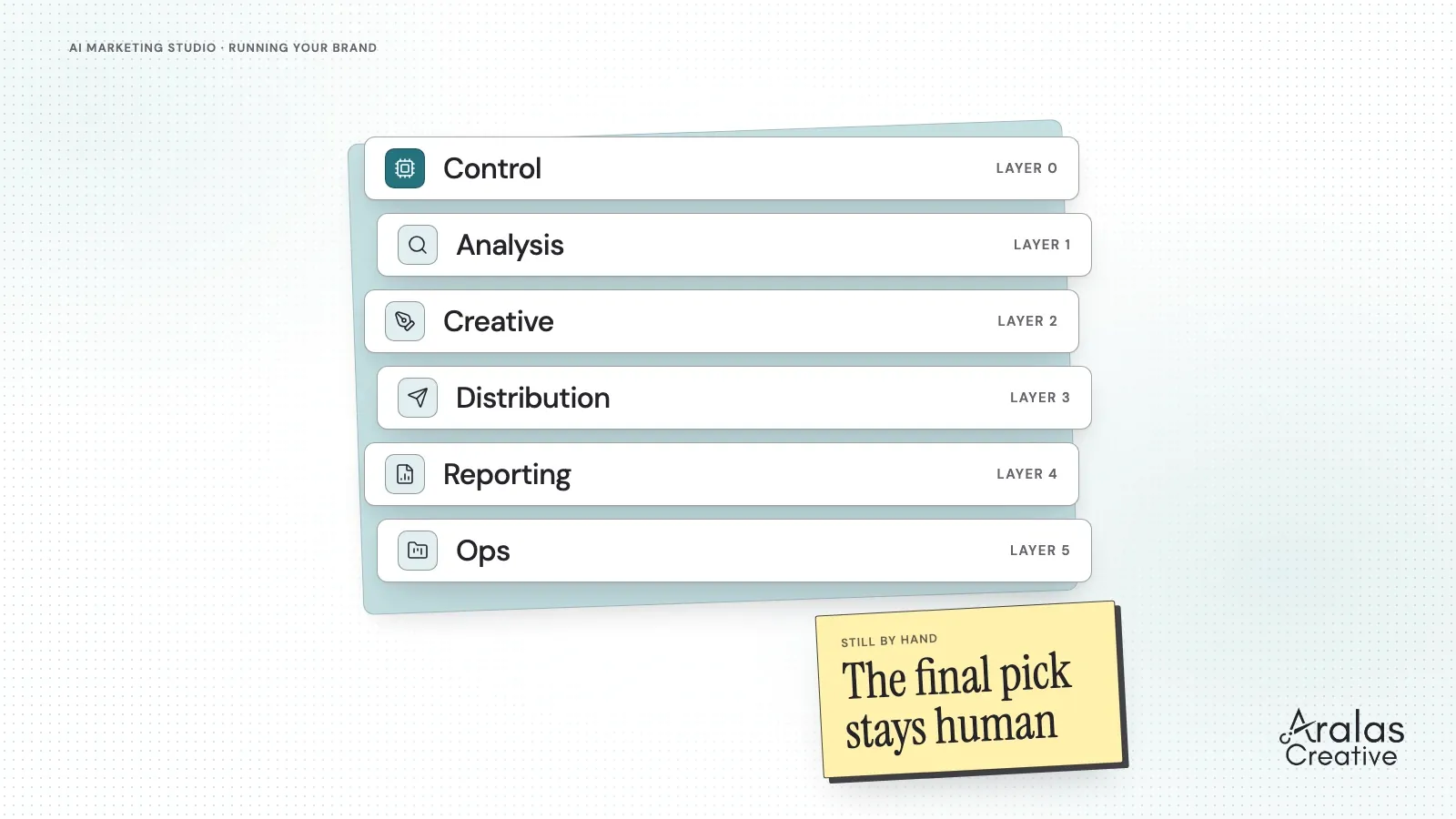
Aralas Creative runs its marketing work through six layers. A control layer connects every tool through MCP. Analysis checks the numbers first in our reporting tool. The creative layer makes many versions and a person picks. Distribution sends the work out, often with open source tools to keep cost down. Reporting goes out under our name from the same tool. Ops keeps the brand, the project and the analysis in three shared places instead of in one person's head. AI does the groundwork. People set the strategy and make the final pick.
If you go to a market and see the same banana selling for half the price, your first thought is that something must be wrong with it. Sometimes, that is true. But it is not true every time. The same product can be sold for a lower price if the unit economics are optimised better.
We face the same question about our AI marketing studio in almost every client meeting and discovery call. People ask us, how is your pricing so low, and is your delivery quality different from others. This article is our answer to that question. (Our pricing is public if you want to see the numbers.)
Here is our full process. We will show you which tools we use, what we use them for, and how our workflow works. With the same tools and the same workflow, you could grow your own D2C brand or run your own agency. We are sharing it upfront so your questions are clear and you get a clear answer.
How can an AI marketing studio cost less without cutting quality?
It costs less when the cost around the human work comes down, not the human work itself. We use AI for the groundwork and the volume, open source tools where they fit, and one tool for reporting. People still set the strategy, make the final pick and check everything before it goes out. We run this across six layers, numbered 0 to 5:
- Layer 0, control: one place that runs every tool.
- Layer 1, analysis: every job starts with the numbers.
- Layer 2, creative: many versions, one human pick.
- Layer 3, distribution: the work goes out, with low tool cost.
- Layer 4, reporting: measure, then improve.
- Layer 5, ops: the work lives in the project.
Layer 0: The control layer, one brain for every tool
To run the agency, we have to use countless tools.
All of those tools are controlled and run from one orchestration tool. We call it the control layer.
For us, the AI tool itself sits on top of this control layer. In my case, it is Claude, in Claude Code. For some team members, it is ChatGPT. Sometimes we use Qwen or DeepSeek.
The model can change. The job stays the same.
The control layer connects to everything through MCP, the open standard that lets an AI tool talk to other software. Our client sites are mainly Shopify or WordPress. Our analytics connects through SnowDots, a reporting tool I’m building, and MCP. I ask in one place, and it calls the right tool.
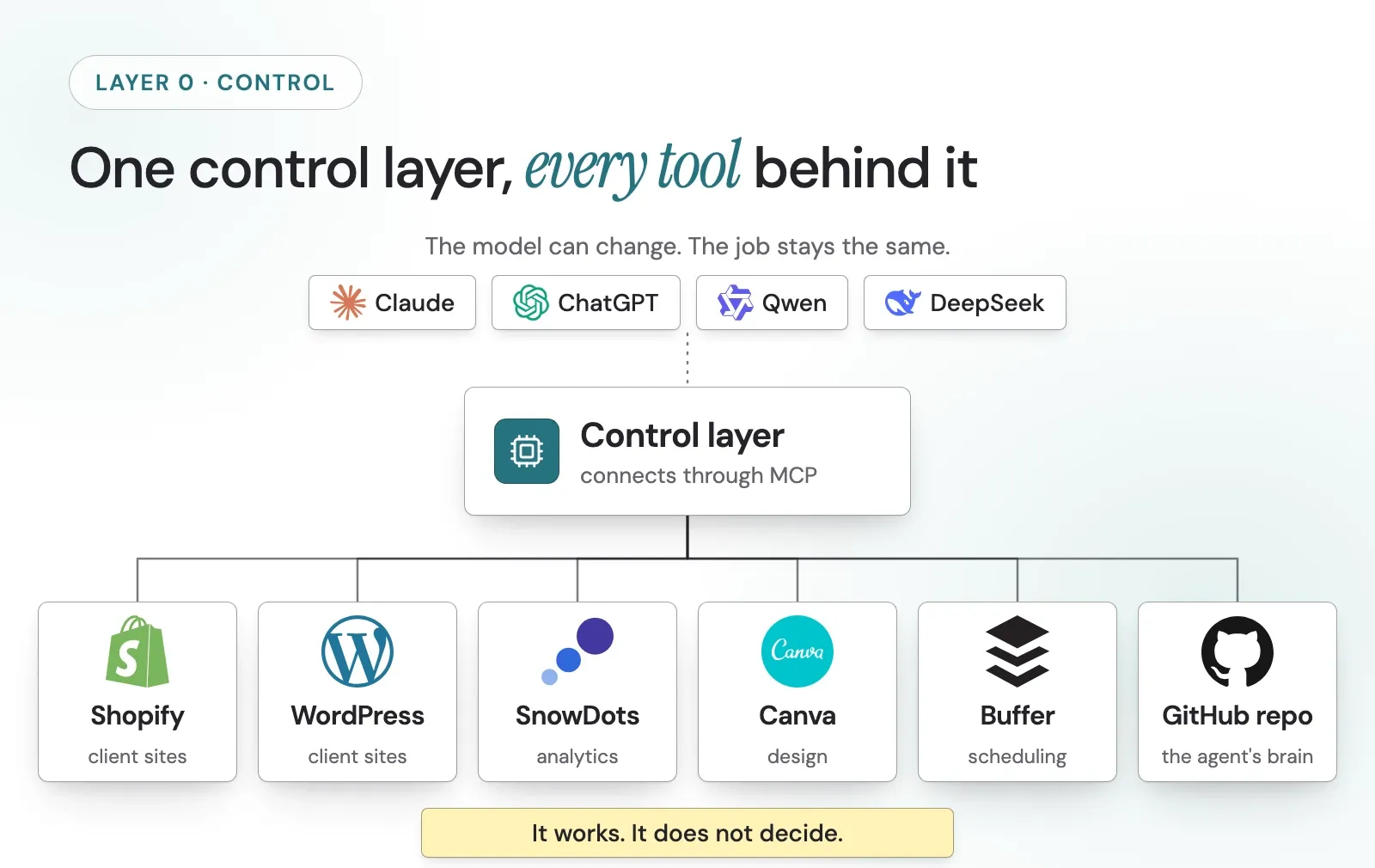
Every project has a GitHub repository. That is where the agent’s brain lives. Claude Code reads from it and works from it. So the work does not live in one person’s head, and it does not disappear when a chat closes.
The control layer works. It does not decide. The final pick stays with a human.
Layer 1: Analysis, where every job starts
Every job starts with analysis, whatever the job is.
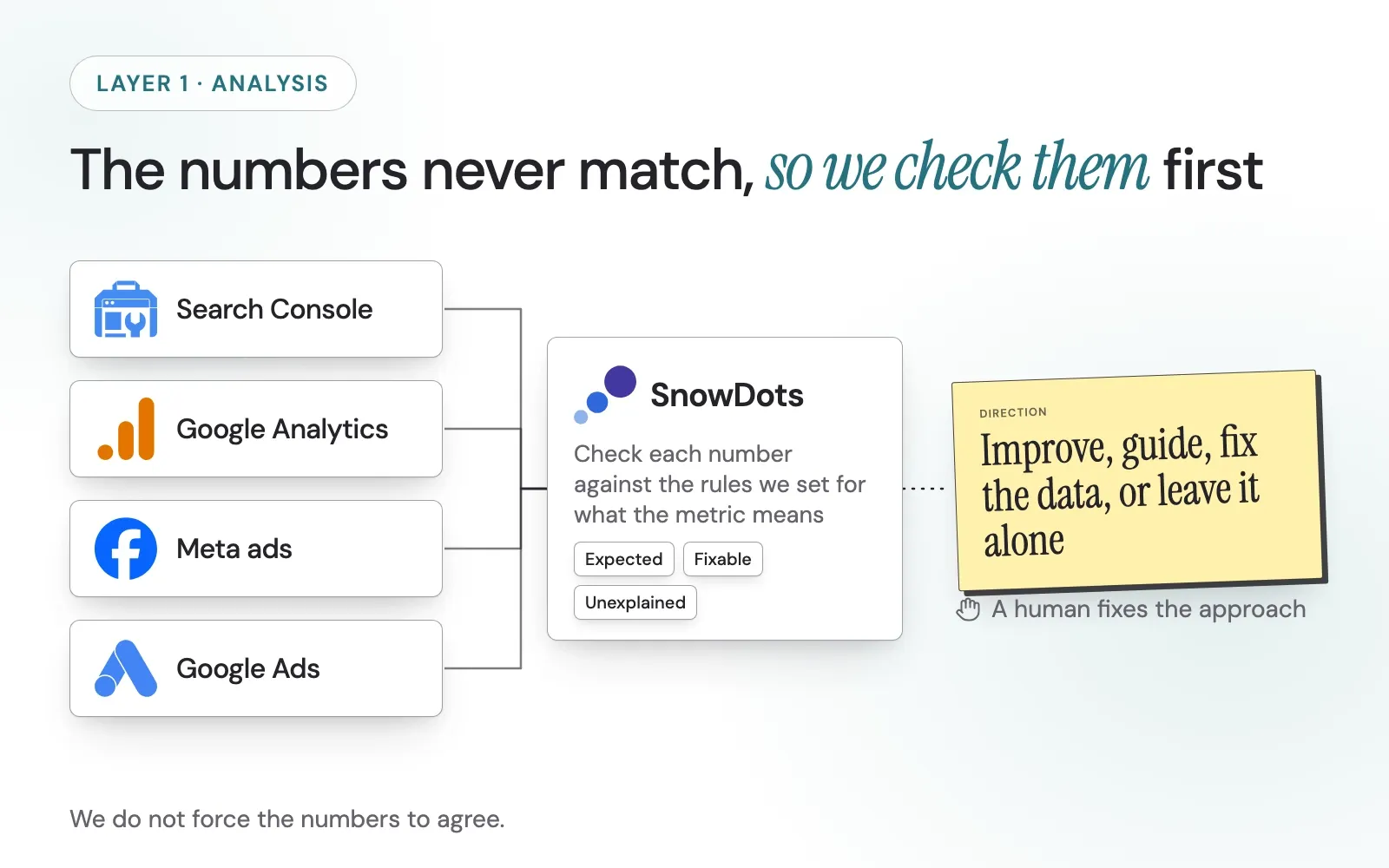
Instead of opening five dashboards, we ask Claude once. Search Console, Google Analytics, Meta ads, and Google Ads all come in through MCP, from one connection or from each platform’s own MCP. We hardly touch any of them by hand.
The numbers never match on their own. Each platform counts in its own way. So we check them in our reporting tool first, against the rules we set for what each metric means. Some gaps are expected, some can be fixed, and some stay unexplained. We do not force the numbers to agree. (I wrote about the same problem for Black Friday and repeat customers, where Shopify, Klaviyo, GA4 and the ad platforms each tell a different story.)
A product page shows how this works. We start with the product, not a keyword. Keyword first used to be our way. Now it is product first, and topic first.
We look at what the page already ranks for in Search Console, what people already click, and where it sits. Then the Ahrefs MCP shows what our competitors rank for, and where the gap is. From that, the approach becomes clear. Improve the page, write a buying guide, fix the product data, or leave it alone. If you want to see this work applied to search, it is what sits behind our SEO and AI search service, and it is also how we think about getting named in AI answers.
Analysis gives us the direction. A human still fixes the approach.
Layer 2: The creative layer, because one version is never enough
Creative starts where analysis ends. A blog, a product page, or a social post, it is the same first step.
We do a lot of competitive analysis first. We look at what is already ranking, what it covers, and what it leaves out. That tells us what our version has to do better.
Every piece has one job. For a blog, the job is to rank on Google. So we optimise it for that job, and for nothing else.
We do that with Claude, and with the platform MCP. For WordPress, it is the WordPress MCP. For Shopify, it is the Shopify MCP. The work happens inside Claude, and the change goes straight to the platform. There is no copy and paste in between.
For this work, we have our own skills and an agentic process. The skill holds how we do the job. The process makes a version, checks it, and improves it. Then it makes the next version, and improves that one too. We keep going until the version is best in class. That is our main workflow.
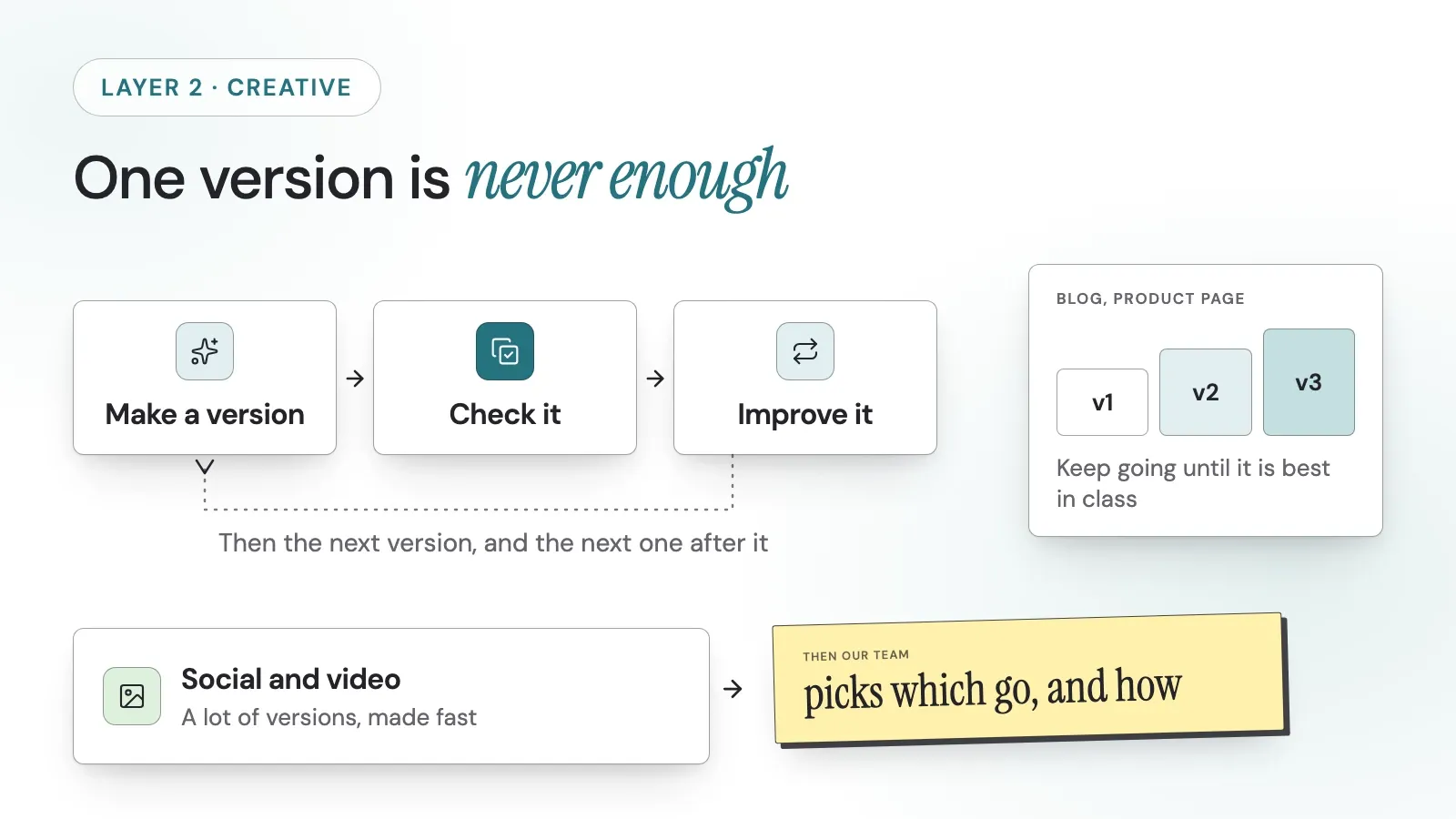
Social and video creative work differently. There, we make a lot of versions. A lot. Then our team picks which ones go, and how they go. Sometimes we run a small test first, and only then we post the real one. This is the work behind our social content service, and the same idea carries into paid campaigns, where more versions means more to test. If you are deciding how much to put behind them, how much to spend on Meta ads walks through the math.
Visuals start from a real product photo. For design, we use Canva with its MCP, from inside Claude. For image creation, we use the Nano Banana API or the ChatGPT API, also controlled from inside Claude or ChatGPT.
Nano Banana is for product image editing. It edits a real photo, and keeps the product the same. We change the setting, the background, or the styling, and one good photo becomes more posts and pins. The product has to look exactly as it does in real life. Same shape, same colour, same details, same size.
ChatGPT API is for the rest. Detailed style prompts, illustration, and images where the look matters more than keeping a real product exact.
AI does the volume. We keep the taste.
Layer 3: The distribution layer, because the work has to go out
Creative is done. Now the work has to go out.
We use Buffer, and different scheduling tools. Sometimes we use Canva’s own scheduling tool, straight from the design. The tool changes. The job stays the same. The post goes out on time, on the right channel, in the right size.
Email goes out the same way, with different tools for different jobs. And here, we make a choice that matters for our pricing.
A large part of the time, we use open source tools. We do it to keep the cost down. That cuts the client’s cost too, not only their marketing budget, but their tool cost as well.
Take email on a WordPress site. Klaviyo and Mailchimp bill every month, and the price climbs as your list grows. Klaviyo’s paid email plan starts at $20 a month for 500 profiles, and goes up from there. FluentCRM is a WordPress plugin with a yearly licence that does not depend on list size. At list price it is $129 a year for one site (we checked on 16 November 2026). You still pay for a sending service, so it is a saving, not free. For a brand with a growing list, that gap adds up.
That is part of the answer to the first question in this article. Our price is low because we keep the cost low, everywhere, not only in the work, but in the tools too.
Layer 4: Analytics and reporting, to see what is working
After the work goes out, we measure it.
We tag every link. We compare the numbers with where we started. And we report each month.
For reporting, we use SnowDots, the same tool we use for analysis and the one I’m building. It has white label, so the report goes to the client in our name.
The report shows what we delivered, how the numbers compare with the starting point, and what we will change next. That is the loop. Measure, then improve, then measure again.
The data comes from the same place as the analysis. Search Console, Google Analytics, Meta ads, and Google Ads, through MCP, checked in our reporting tool first.
Layer 5: Ops, how the work stays organised
The work does not live in one person’s head. It lives in the project.
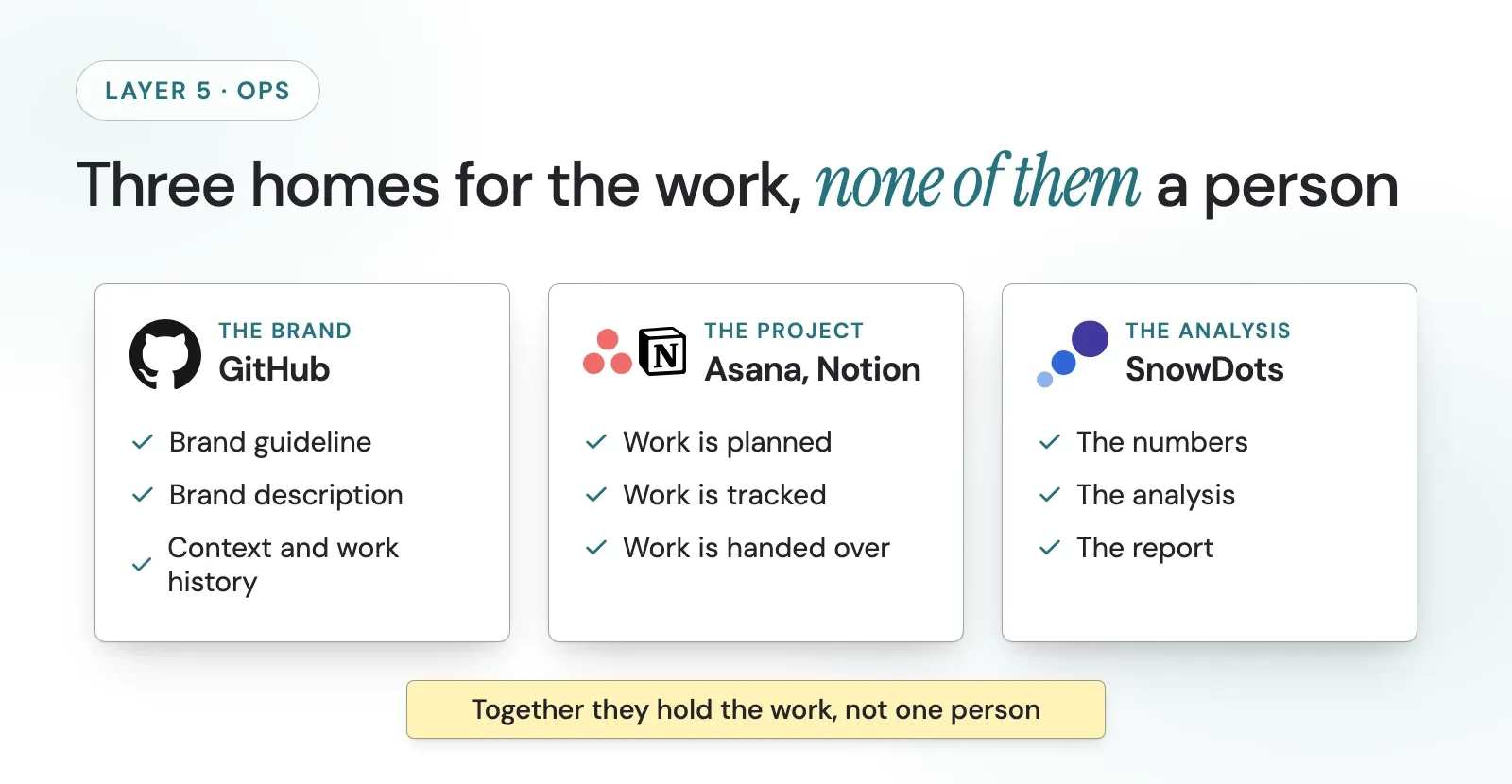
Every project has a GitHub repository. That is where the agent’s brain lives. The brand guideline lives there. The brand description lives there. The context, the brand history, what we are doing, and our work history, all of it lives there. Claude Code reads from it and works from it.
For project management, we use Asana and Notion. That is where the work is planned, tracked, and handed over.
And when we make a report or an analysis, the context for that work lives in the same reporting tool. So the numbers, the analysis, and the report stay together, in one place.
So a new person can pick up the work, and the work does not disappear when a chat closes. GitHub holds the brand, Asana and Notion hold the project, and SnowDots holds the analysis. Together, they hold the work, not one person.
What our AI marketing studio still does by hand
AI does the groundwork. We decide.
We set the strategy. We fix the approach. We pick which creative goes, and which one does not. We check every post, pin, page, and email before it goes out. We compare every AI variation with the original photo.
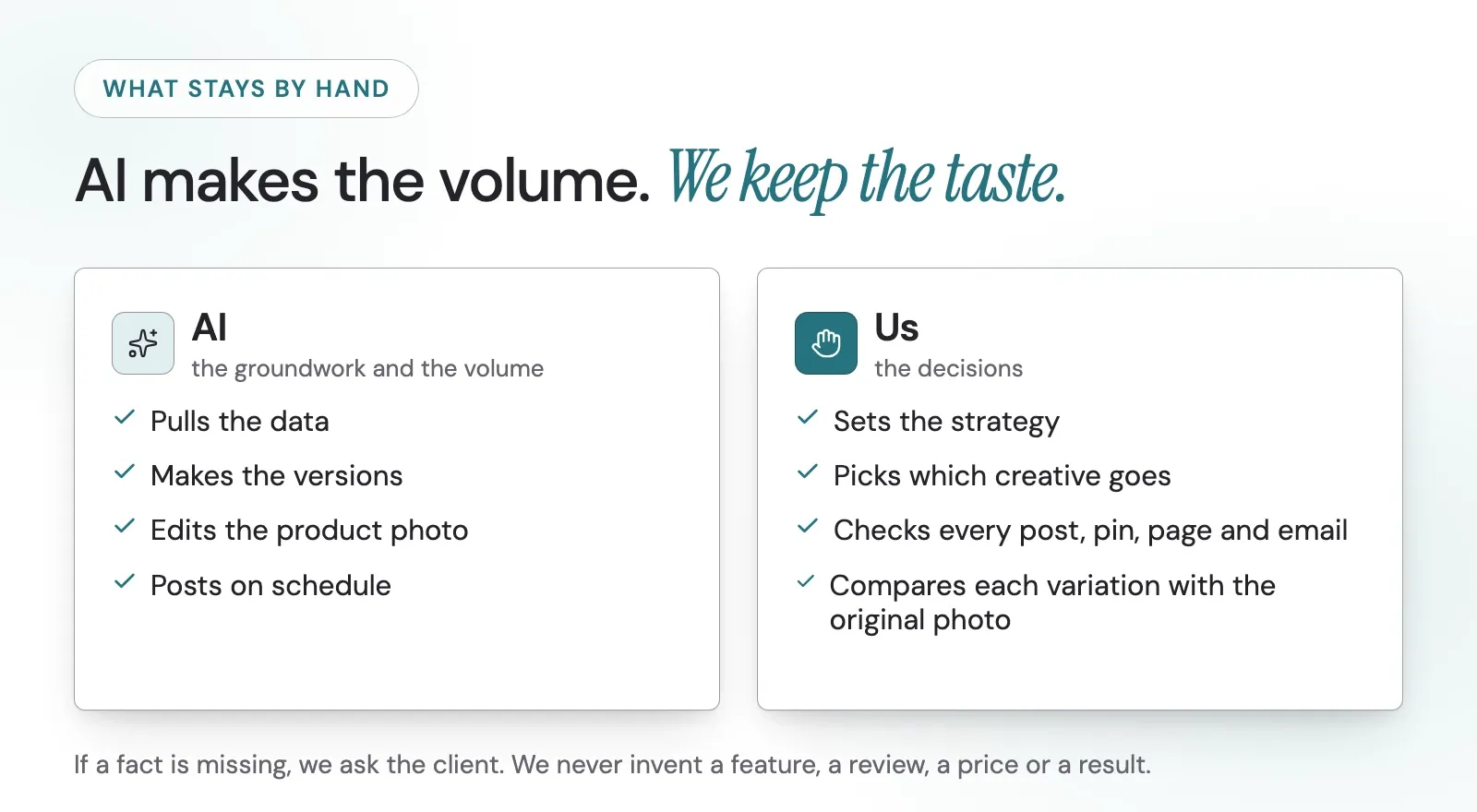
We do not let AI change what a product is. We do not invent a feature, a review, a price, or a result. If a fact is missing, we ask the client.
That is the part we keep. AI makes the volume possible. The taste, the judgment, and the final pick stay with a human.
That is also why the price can be low. We did not cut the human part. We cut the cost around it. The tools cost less, the volume costs less, and the human work stays where it matters.
If you would like this kind of setup for your own brand, start with our services or see how we price them.
Common questions
Why is Aralas Creative's pricing lower than other agencies?
We keep the cost low everywhere except the human work. We use AI for the groundwork and the volume, open source tools where they fit, and one reporting tool. The strategy, the final pick and the checking still come from people.
Which AI model do you use?
It depends on the person. Omar uses Claude in Claude Code, some team members use ChatGPT, and we sometimes use Qwen or DeepSeek. The control layer stays the same when the model changes.
What do you use for client reporting?
We use SnowDots, the same tool we use for analysis. It has white label, so the report goes to the client in our name each month and shows what we delivered, how the numbers compare with the starting point, and what we will change next.
Does AI write and publish everything for you?
No. AI makes the versions. A person decides which ones go out and checks every post, pin, page and email before it does. We never let AI invent a feature, a review, a price or a result.
Could I run my own agency or D2C brand with this workflow?
Yes. The tools and the layers are described in the article. What you add is your own skills, your own checks and your own taste.
Sources & further reading

Omar Sohrab
Omar works across content strategy, search and technical operations. He connects useful publishing with the systems that help people discover it.
Author profile ↗PUT IT INTO PRACTICE
Put the idea to work.
Want help with the work behind a consistent brand presence? Explore the services and choose the support that fits.
Explore our services ↗A correction or a question? Let us know. Read our editorial policy.