The short answer
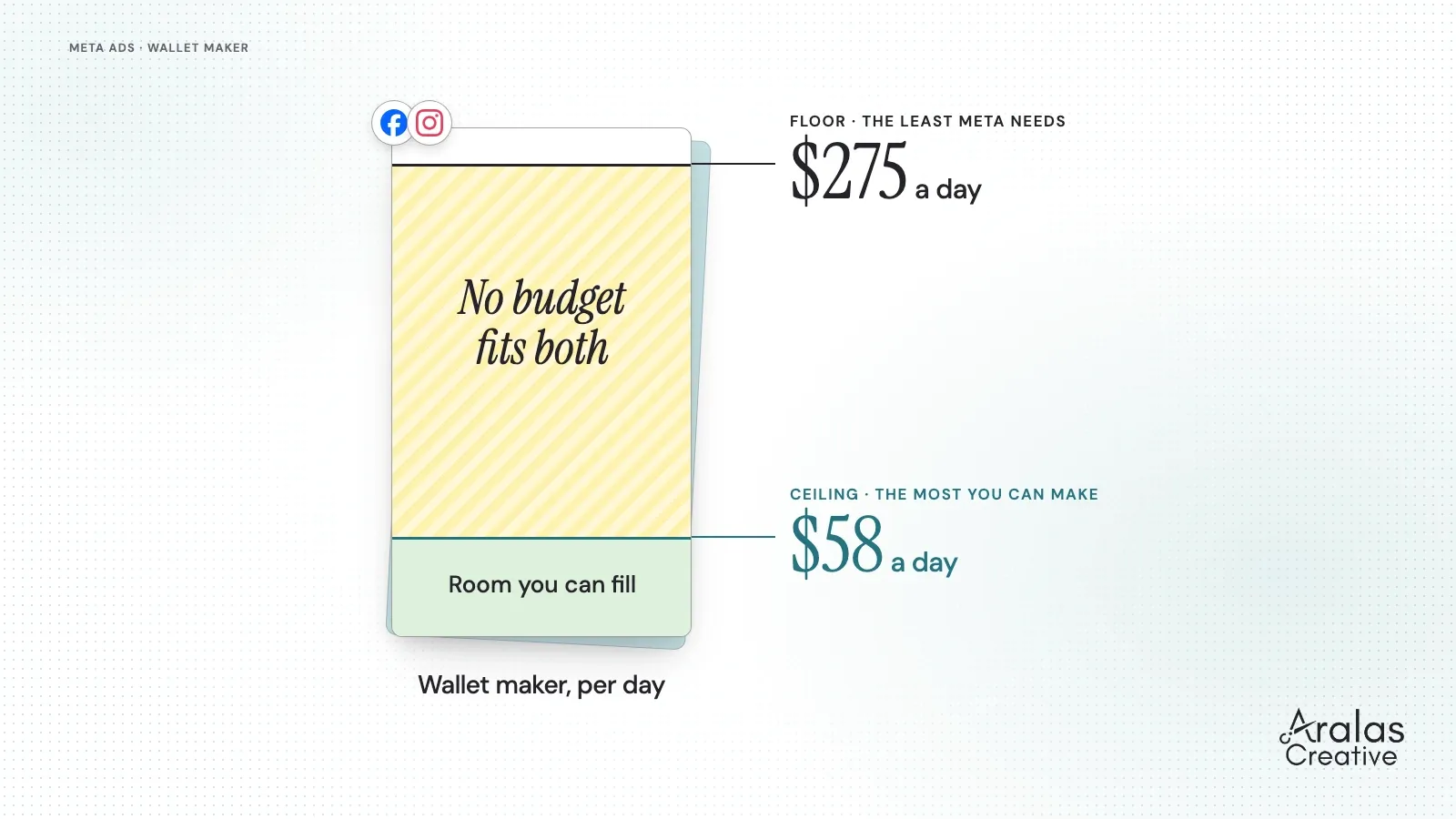
Set your Meta ad budget from how many pieces you can make in a week, not by feel. Work out what one sale is worth after you pay yourself, then find two numbers: a ceiling (the most you can spend without drowning your workshop) and a floor (the least Meta needs to learn who buys). For a wallet maker, the ceiling is $58 a day and the floor is $275 a day. When the floor sits above the ceiling, fix that first, then raise spend slowly and watch your backlog.
What to take away
- Too much money piles up late orders. Too little leaves Meta unable to learn who buys. Both come from picking a budget by feel.
- Start with what you keep after paying yourself. For a $140 wallet that is $51.30, which makes the target cost per sale about $38.
- Ceiling (most to spend) = ads orders × target cost per sale ÷ 7. Floor (least Meta needs) = target cost per sale × 50 ÷ 7. For the wallet maker that is $58 and $275 a day.
- If the floor is above the ceiling, pick a fix first: a smaller action like Add to Cart, selling in windows, pre-orders, a better process or more capacity.
- Raise slowly, give each test a full week, and watch your backlog against the lead time you promise.
Say your ads finally work. Day one brings 3 orders. Day four brings 11. By day nine you have 60 open orders, a 20-hour week at the bench, and a customer asking where her wallet is.
Remember the chocolate factory in I Love Lucy, with candy coming down the belt faster than Lucy can wrap it? That’s what too much ad money does to a workshop.
So you pull back and spend $5 a day. Two weeks later nothing has sold, and you decide ads don’t work. That’s the other mistake.
Both come from the same place. You picked a budget by feel, and the number never touched the one thing that matters: how many pieces you can make in a week. Fix that and you get two numbers to work with. The most you should spend, and the least Meta needs.
Why the two mistakes fight each other
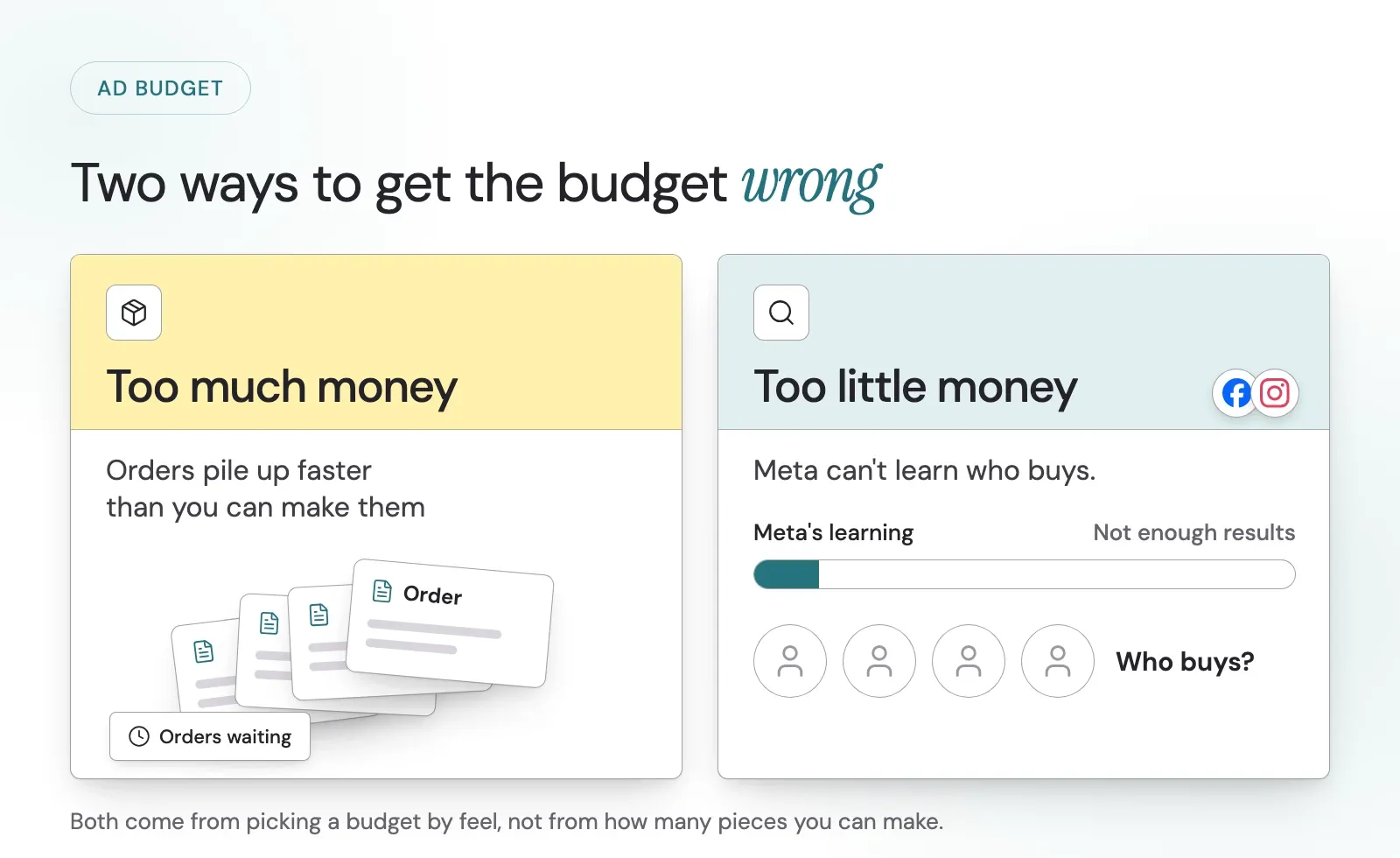
Too much money means late orders, bad reviews and refund requests. A common line in Etsy seller forums is to stop advertising until you catch up. One handmade-ads guide calls the classic mistake running ads like you sell stock off a shelf, when you make every piece to order (FiveX).
Too little money starves Meta (Facebook and Instagram’s ad system). Meta starts every new ad set (one group of ads with its own budget) in a trial period called the learning phase, where it figures out who buys from you. Its own docs say it wants about 50 results in 7 days, and a result is the action you picked, usually a purchase (Meta). Miss that and you get a “Learning limited” label. Meta says it’s not a penalty. It just means Meta can’t do its best work.
Now the squeeze. If you make wallets by hand, Meta wants 50 sales a week and you can make 14. Let’s put real numbers on it.
Step 1: What is one sale worth to you?
Start with the contribution margin, which is just what you keep from a sale before ads. Take the price, then subtract materials, packaging, shipping you pay, fees, and a small cushion for refunds. Then take off your own time too, at your normal hourly rate. If you skip that, you’re running ads for free labor.
Say you sell a leather wallet for $140.
| Amount | |
|---|---|
| Price | $140.00 |
| Leather, hardware, packaging | $31.00 |
| Shipping you pay | $9.00 |
| Fees (5%) and refund cushion (3%) | $11.20 |
| Kept before your time | $88.80 |
| Your time: 90 min at $25/hour | $37.50 |
| Kept after paying yourself | $51.30 |
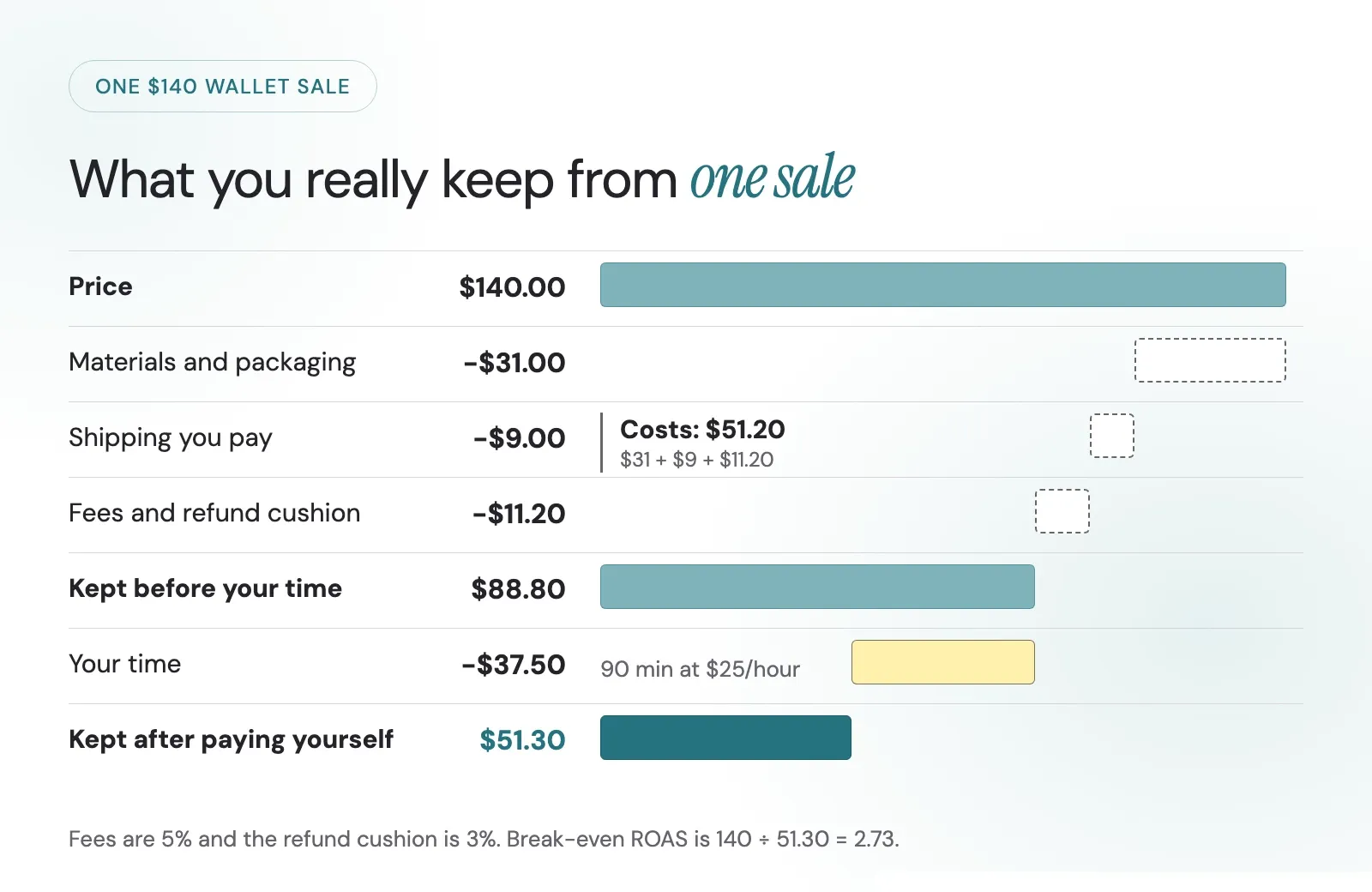
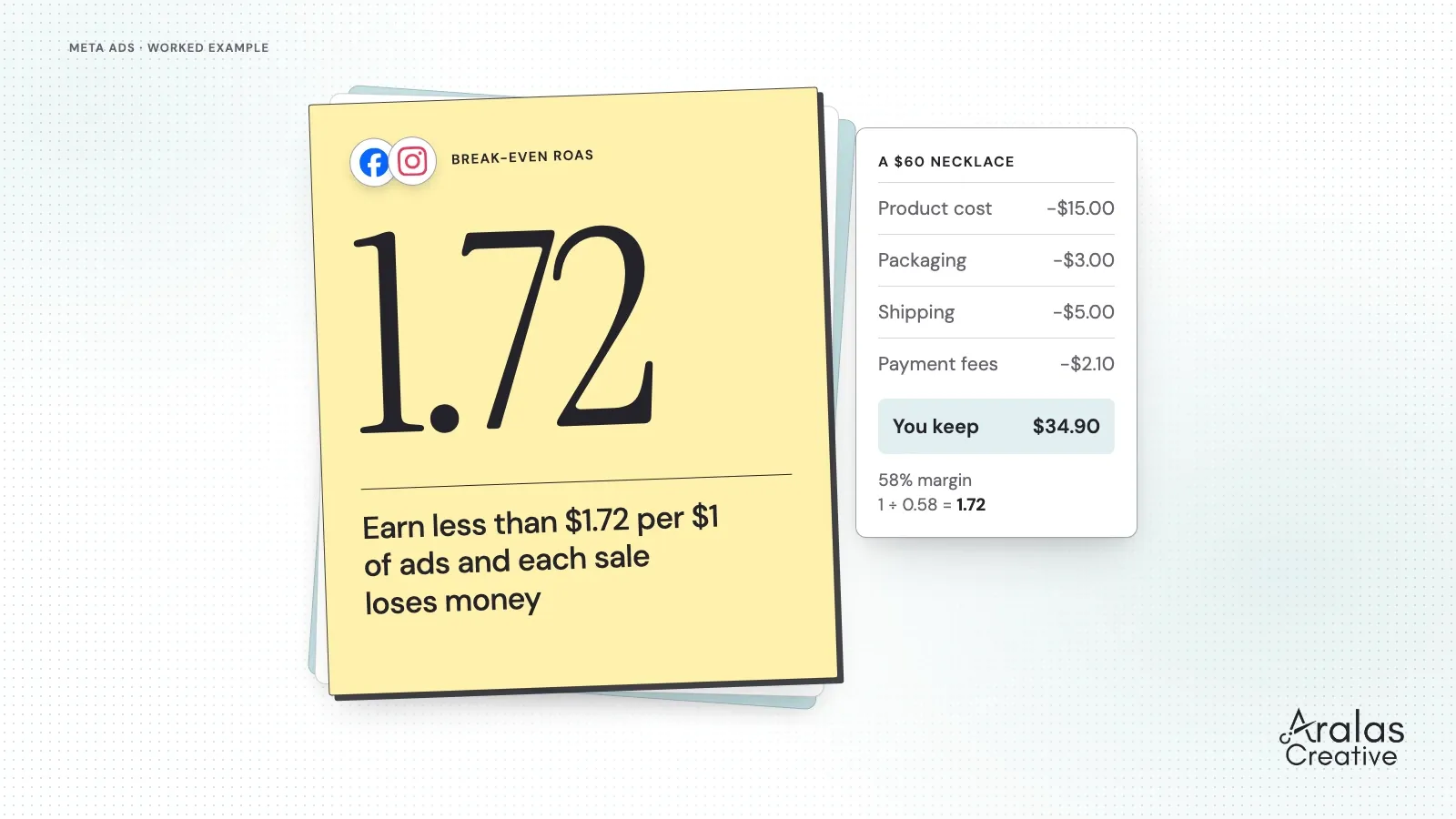
Now your break-even ROAS. ROAS is return on ad spend: dollars back for each ad dollar. Divide the price by what you keep: 140 ÷ 51.30 = 2.73. Below that, you earn less than your hourly rate (Triple Whale).
Two traps. Don’t use gross margin, because it ignores shipping and fees. And a 20% sale can cut what you keep by about half, which doubles the ROAS you need while it runs (Venon).
Break-even isn’t a goal, so leave some profit. Your target cost per sale (CPA, what you pay in ads to land one order) is 75% of what you keep after paying yourself: $51.30 × 0.75 = about $38. That’s roughly $3.60 back for every ad dollar.
Step 2: How many can you actually make?
That’s the part ad dashboards never ask.
Weekly capacity = making hours × 0.85 ÷ hours per piece
Count only bench hours. Packing, email and photos eat the rest. The 0.85 covers slow days and setup.
With 25 bench hours and 1.5 hours per wallet, that’s 14 wallets a week. Keep a quarter for repeat buyers and markets, and you can give ads about 10 orders a week.
Step 3: Your ceiling and your floor
Now both numbers show up.
Ceiling (most to spend) = ads orders × target cost per sale ÷ 7 Floor (least Meta needs) = target cost per sale × 50 ÷ 7
For the wallet maker:
- Ceiling: 10.6 × $38 ÷ 7 = $58 a day. Spend more and you’re buying orders you can’t make.
- Floor: $38 × 50 ÷ 7 = $275 a day.
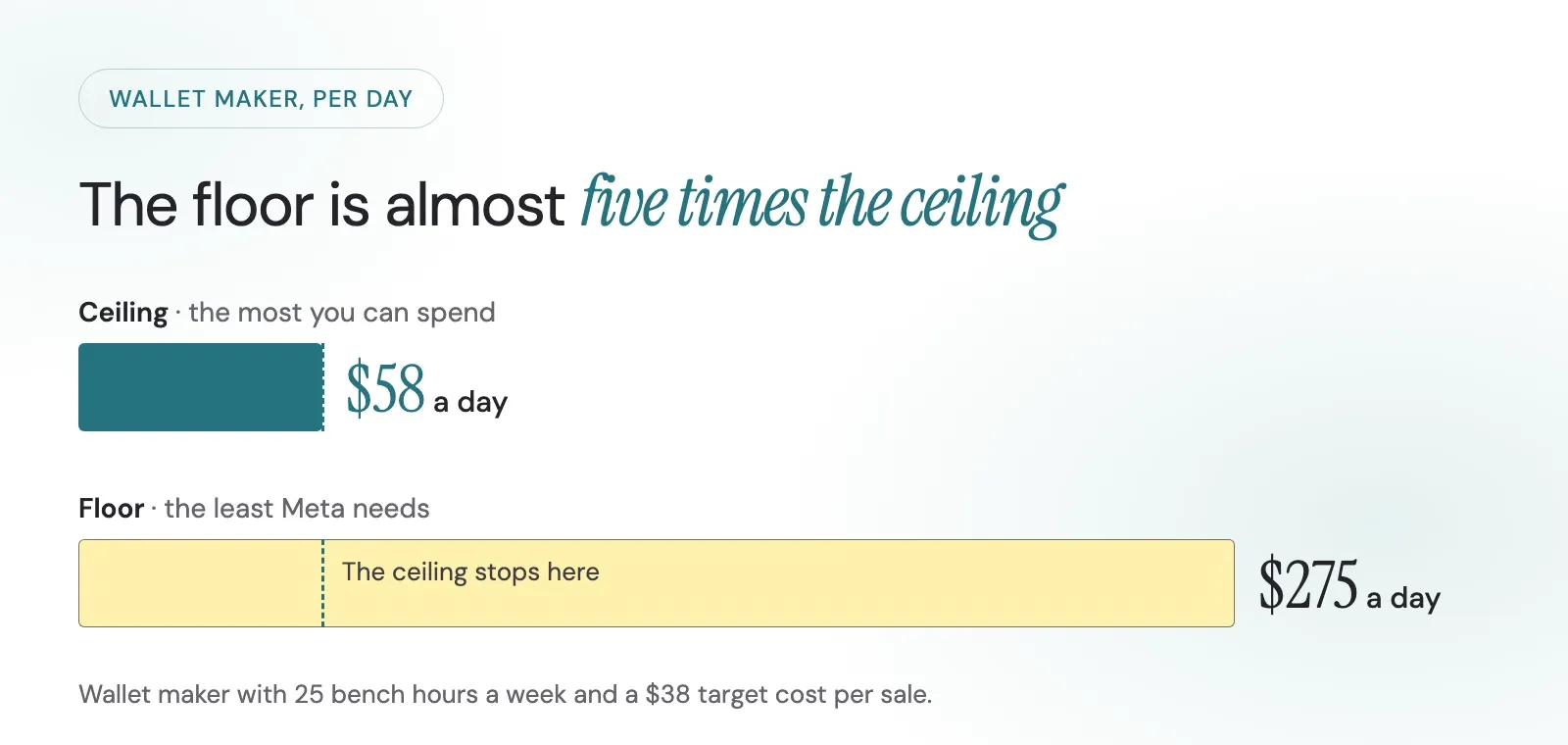
The floor is almost five times the ceiling. That’s the squeeze. Here it is for three makers, each with 25 bench hours (20 for planters):
| Wallet | Planter set | Soy candle | |
|---|---|---|---|
| Price | $140 | $95 | $28 |
| Kept after paying yourself | $51 | $34 | $8.54 |
| Target cost per sale | $38 | $26 | $6.40 |
| Orders you can make a week | 14 | 17 | 106 |
| Ceiling per day | $58 | $47 | $73 |
| Floor per day | $275 | $184 | $46 |
| Problem | Can’t make enough | Can’t make enough | Margin too thin |
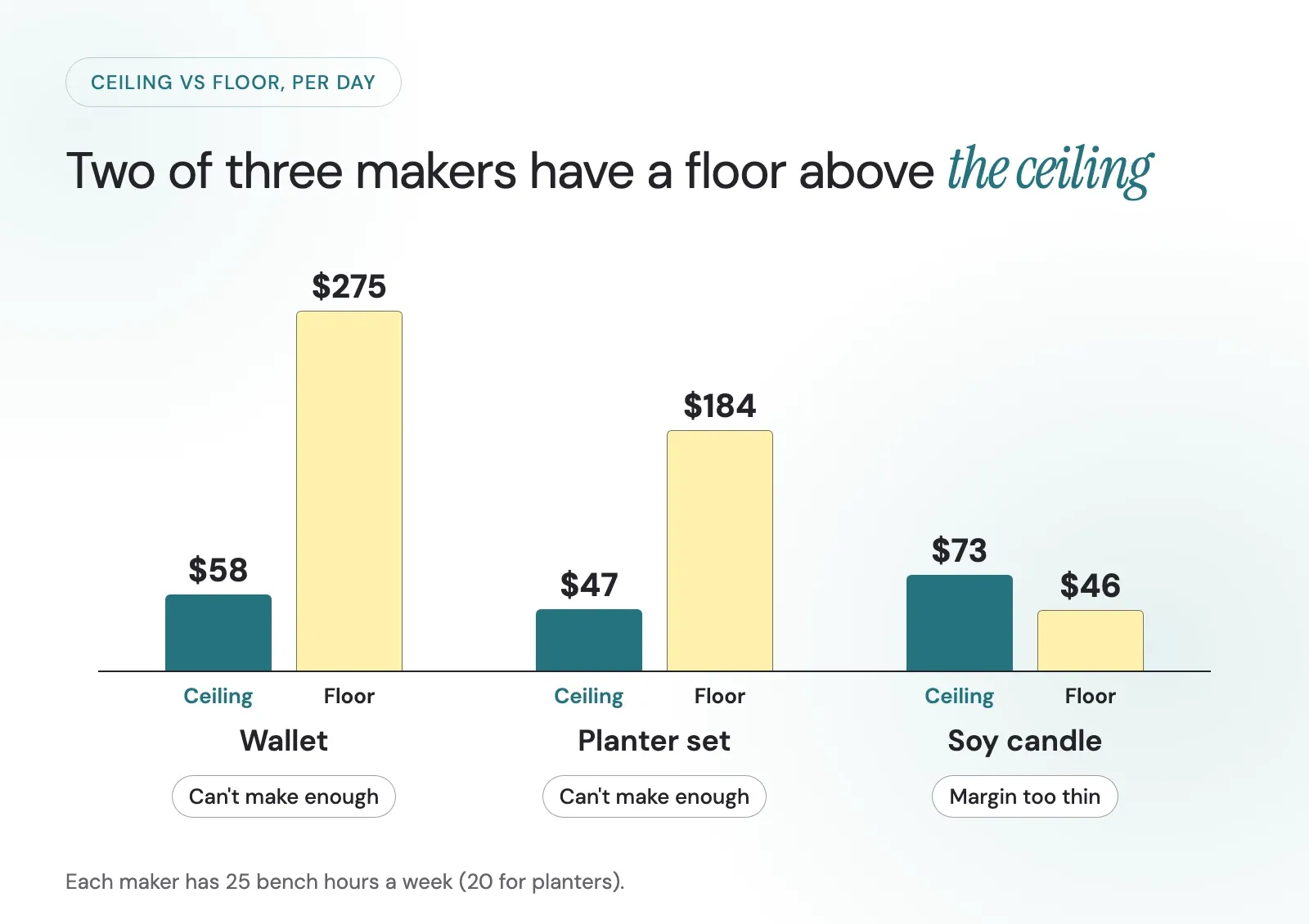
Slow makers with high prices have a capacity problem. The candle maker has the opposite one. One data company puts the average cost per online sale around $45 (SuperAds). That’s not a handmade number, so test your own. But a $6.40 target won’t survive that. The fix is a bigger order, like a bundle of three at $72, which lifts the affordable cost per sale to about $21. Notice what happens next: capacity drops to about 35 orders and the floor jumps to $147 a day. Raising the order size swaps a margin problem for a capacity problem. One lever won’t fix both.
How real makers get out of the squeeze
None of these brands publish their ad budgets, so I can’t tell you what they spend. What they show is how to control the line. In Seinfeld, the Soup Nazi never made more soup than he could make right, and the line outside was the marketing.
Ask Meta to chase a smaller action. Instead of purchases, optimize for Add to Cart. It happens far more often, so Meta gets its 50 results for less money. If one cart in six becomes a sale (use your own number), 50 carts a week costs the wallet maker about $46 a day, which fits under the $58 ceiling. The tradeoff is that Meta finds cart-adders, not always buyers, so watch your cost per real sale. This tip comes from ad practitioners, not from Meta.
Sell in windows. Lost Dutchman Leather drops a small batch every Thursday at 8pm Eastern. Once it’s gone, it’s usually gone for good (Lost Dutchman). Misha & Puff runs knitwear in capsules sized to its yarn and knitting time, then closes them (Misha & Puff). Timmermade uses a monthly lottery for access and about 6 weeks to make (Timmermade). The batch size is the cap.
Get paid before you make it. In 2020 East Fork Pottery moved to pre-sale: customers pay first, then the mug gets made. It brought cash in early and let them plan around real orders, but they gave up launching new lines fast (Modern Retail). Asaka Fushimi did something similar for her handmade beanies. Her drops sold out in a minute, so she switched to a small pre-order, ships in one to two weeks, and emails every buyer (Asaka Fushimi).
Fix the process, not just the hours. After Shark Tank, Bottle Breacher reportedly got more than 20,000 orders. They had office staff type in the engraving details ahead of time, so engravers only engraved, and caught up in about two months (SUCCESS). One report says output rose from about 175 a day to around 1,000 (Looper). Sources disagree on exact counts.
Add capacity. East Fork’s mug topped out near 450 a week in 2019 and sold out in minutes every Tuesday (Gear Patrol). They kept the price low, sold a $20 T-shirt to people who missed out, and moved toward machines and molds. A helper for cutting and prep can add more than any ad trick.
Last one: keep it in one ad set. Splitting a small budget over many ad sets means none gets enough to learn.
Running it week to week
Start inside the ceiling. Open at the lower of your ceiling and your floor on the smaller action. For the wallet maker that’s about $46 a day.
Give it a full week. One writer on DEV Community killed a $10-a-day test on day three, with no target cost in mind, and learned nothing (DEV). Before judging any single ad, spend two to three times your target cost on it. That’s my rule of thumb, not Meta’s.
Raise slowly. The usual guide is about 20% every 3 to 4 days. It isn’t an official Meta rule, and Jon Loomer says Meta is more forgiving now. Before each raise, ask four things:
- Is my real cost per sale under target?
- Do I have room for the extra orders?
- Is the ship date on my site still true?
- Would this money do better somewhere else?
Any “no” means hold.
Watch your backlog. Open orders divided by weekly capacity gives you backlog in weeks. These cutoffs are my suggestion:
| Backlog vs the lead time you promise | What to do |
|---|---|
| Under half | Raise if the four questions pass |
| Half to full | Hold |
| Past the full lead time | Cut in half or pause |
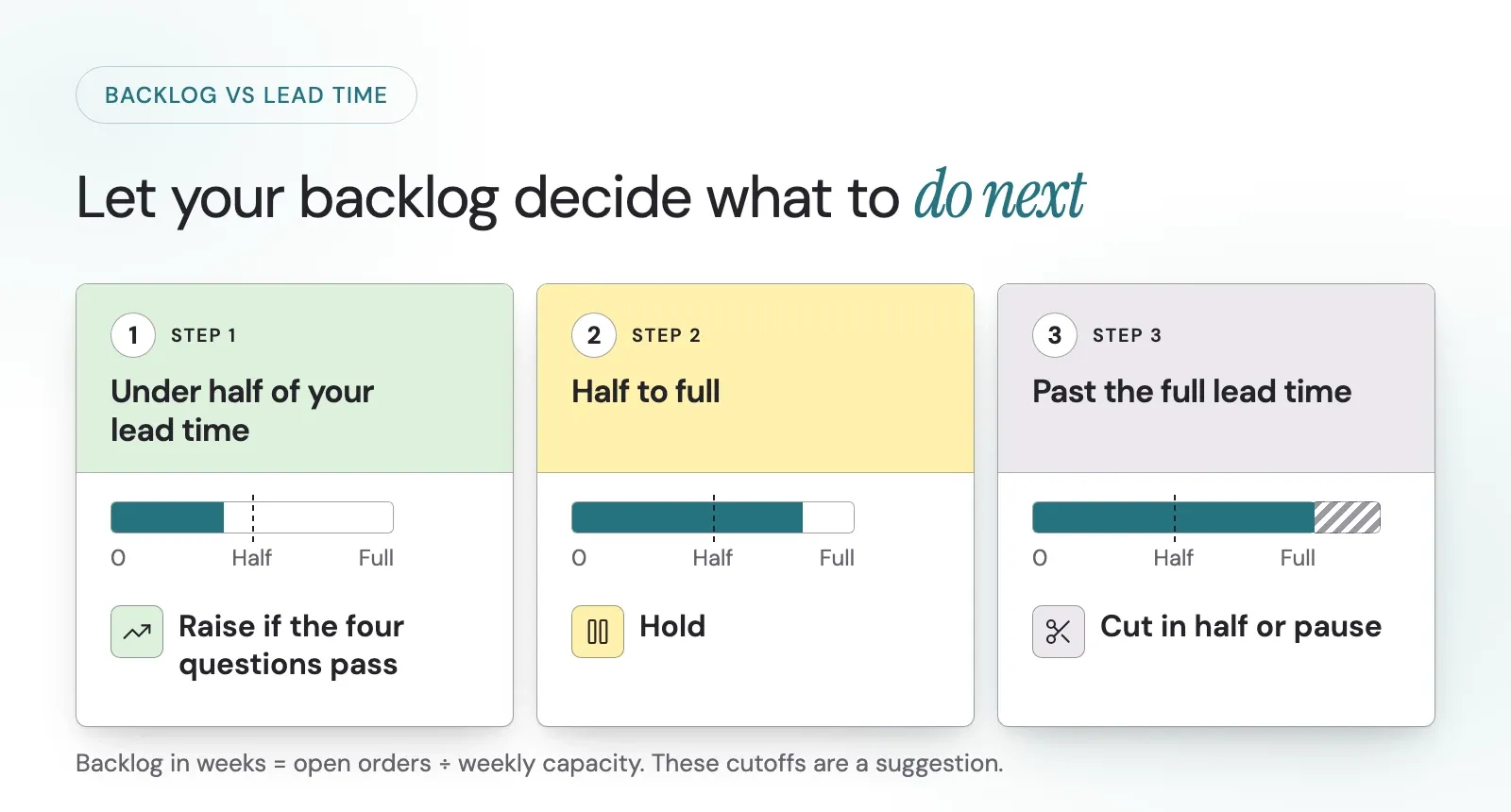
A hard cut may restart Meta’s learning. Take that hit. A late order costs more.
Check your ROAS honestly
Meta counts a sale if someone clicked your ad in the last 7 days or saw it in the last day, even if email or Etsy helped. So compare its number to your real sales. The simple check is MER: total sales divided by total ad spend (Admetrics). And make sure your Pixel and Conversions API (the two ways your shop tells Meta a sale happened) are working, or nothing else matters.
The cheat sheet
| What | How |
|---|---|
| Kept after paying yourself | Price − costs − (minutes ÷ 60 × hourly rate) |
| Break-even ROAS | Price ÷ kept |
| Target cost per sale | Kept × 0.75 |
| Weekly capacity | Bench hours × 0.85 ÷ hours per piece |
| Ceiling per day | Capacity × 0.75 × target cost ÷ 7 |
| Floor per day | Target cost × 50 ÷ 7 |
Ceiling above floor? Run it. Floor above ceiling? Pick a fix above and start there.
Sources & further reading
- FiveX: Amazon Handmade advertising profit gate ↗
- Meta: Understanding and optimizing your ad campaign ↗
- Meta Business Help Centre: About learning limited ↗
- Triple Whale: Breakeven ROAS, definition and formula ↗
- Venon: Ecommerce contribution margin, CM1, CM2 and CM3 ↗
- SuperAds: Facebook ads cost benchmarks for e-commerce (2026) ↗
- Lost Dutchman Leather: Horween Football Big Finn ↗
- Misha & Puff: Made to order ↗
- Timmermade: Handmade outdoor gear ↗
- Modern Retail: How ceramics brand East Fork transitioned to a pre-sale only model ↗
- Asaka Fushimi: Beanie pre-order ↗
- SUCCESS: Bottle Breacher after Shark Tank ↗
- Looper: Whatever happened to Bottle Breacher after Shark Tank? ↗
- Gear Patrol: This coffee mug sells out every time it goes on sale ↗
- DEV Community: The Facebook ads budget math I wish I'd seen before my first $300 ↗
- Jon Loomer Digital: How to approach scaling ↗
- Admetrics: MER vs ROAS ↗

Omar Sohrab
Omar works across content strategy, search and technical operations. He connects useful publishing with the systems that help people discover it.
Author profile ↗PUT IT INTO PRACTICE
Put the idea to work.
Want help with the work behind a consistent brand presence? Explore the services and choose the support that fits.
Explore our services ↗A correction or a question? Let us know. Read our editorial policy.