The short answer
To market a jewelry making kit shop, start with the buyer: people buy kits to make something, so your marketing has to help them finish. Use Pinterest, search, short video, Etsy and creators to find new customers. Make visitors buy by answering three questions on the page: can I do this, will it look good, is it worth it. Earn trust for the next purchase by getting them to finish, replying fast and offering the next kit. Start with what's free before you pay for ads.
What to take away
- Kit buyers want to make something, not just wear it. The pride only comes if they finish, so your job is to help them reach the end.
- Channels do different jobs. Pinterest, search, short video, Etsy and creators find new customers. Tutorials and buyer photos win the sale. Email, level-two kits and bundles sell the second kit.
- Start with what's free and slow (Pinterest, short video, tutorials, your email list), add Etsy and creators for faster first sales, and use paid ads last.
- Visitors buy when the page answers three questions: can I do this, will it look good, is it worth it. Show the skill level, the time to finish, a video for that kit and buyer photos.
- Trust for the next purchase comes from the first week: help them finish, reply fast, ask for the photo, then offer the next kit.
You’ve just launched your first jewelry making kit. Maybe you’re still working out how to get sales. Or maybe you already have: your ads are running and people are buying.
But something doesn’t add up. Fewer customers come back to reorder than with your finished jewelry. A few even leave negative reviews. And you can’t tell whether the problem is the kit, the product page or the marketing.
This guide covers everything you need to know about building a jewelry making kit brand and marketing it. We start with the buyer’s philosophy, how kit buyers think and what that means for every choice you make. Then we go through the channels and strategies that work, so you know where to spend your time and money, and where not to. And we finish with how to build a brand people remember and market it without breaking your bank.
Understanding the buyers and their philosophy
Every business comes down to people, so the first thing to understand is the people buying: who they are, why they buy and when. Let’s get to know them.
Who buys jewelry making kits?
Let’s start with who. Unlike a finished piece of jewelry, a kit isn’t bought by everyone who loves a pretty piece. Kit buyers love crafting, and many want to make a personal gift. We see this every day on our blog, The Craftaholic Witch, where readers come for jewelry tutorials because they want to make the piece themselves.
The same kit can sell to a beginner starting a hobby, a daughter buying for her mother or a host planning a group night. Each has a different worry and a different place they look first.
| Buyer | What they want | What worries them |
|---|---|---|
| Curious beginner | A piece they made and can wear | “I’m not crafty” |
| Gift giver | A present that isn’t another candle | The recipient won’t finish it |
| Host | An activity for a group night | Mess, mismatched supplies |
| Parent of a teen | Something screen-free that isn’t childish | Tiny parts, cheap-looking results |
| Upgrader | A new technique or better materials | Another box of the same basic beads |
Pick the one or two your kit is built for. You’ll write their personas at the end of this section.
Why they buy
Have you ever assembled IKEA furniture? If you have, you’ve probably noticed that the pieces you built yourself feel closer to your heart than the ones you didn’t.
That’s called the IKEA effect: when people put their effort into making something, they tend to care about it more. The same thing happens when someone makes jewelry from a kit.
So, they buy a kit for the pride of saying “I made this,” or for the pleasure of giving a gift that took effort. They aren’t buying it just to wear it.
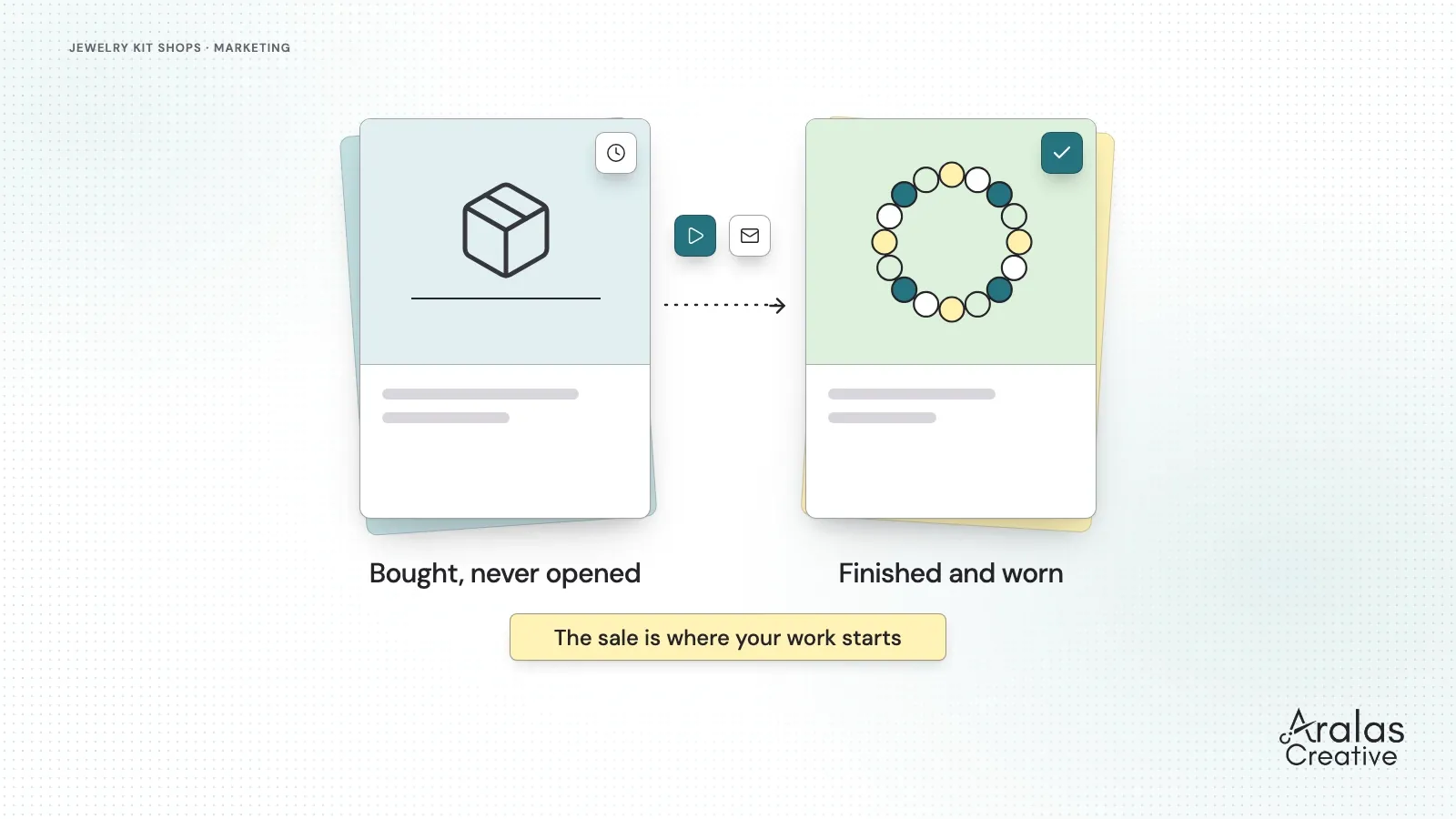
There’s a catch: the feeling only comes when they finish. A kit that never gets finished leaves a box on a shelf, and sometimes a negative review. So your job is to help them finish.
When they buy
So when do they buy? Most kit sales start in one of two ways:
- A date is coming. A birthday, Valentine’s Day, Mother’s Day or Christmas. Gift buyers work backward from the date, so they need to know your last order date.
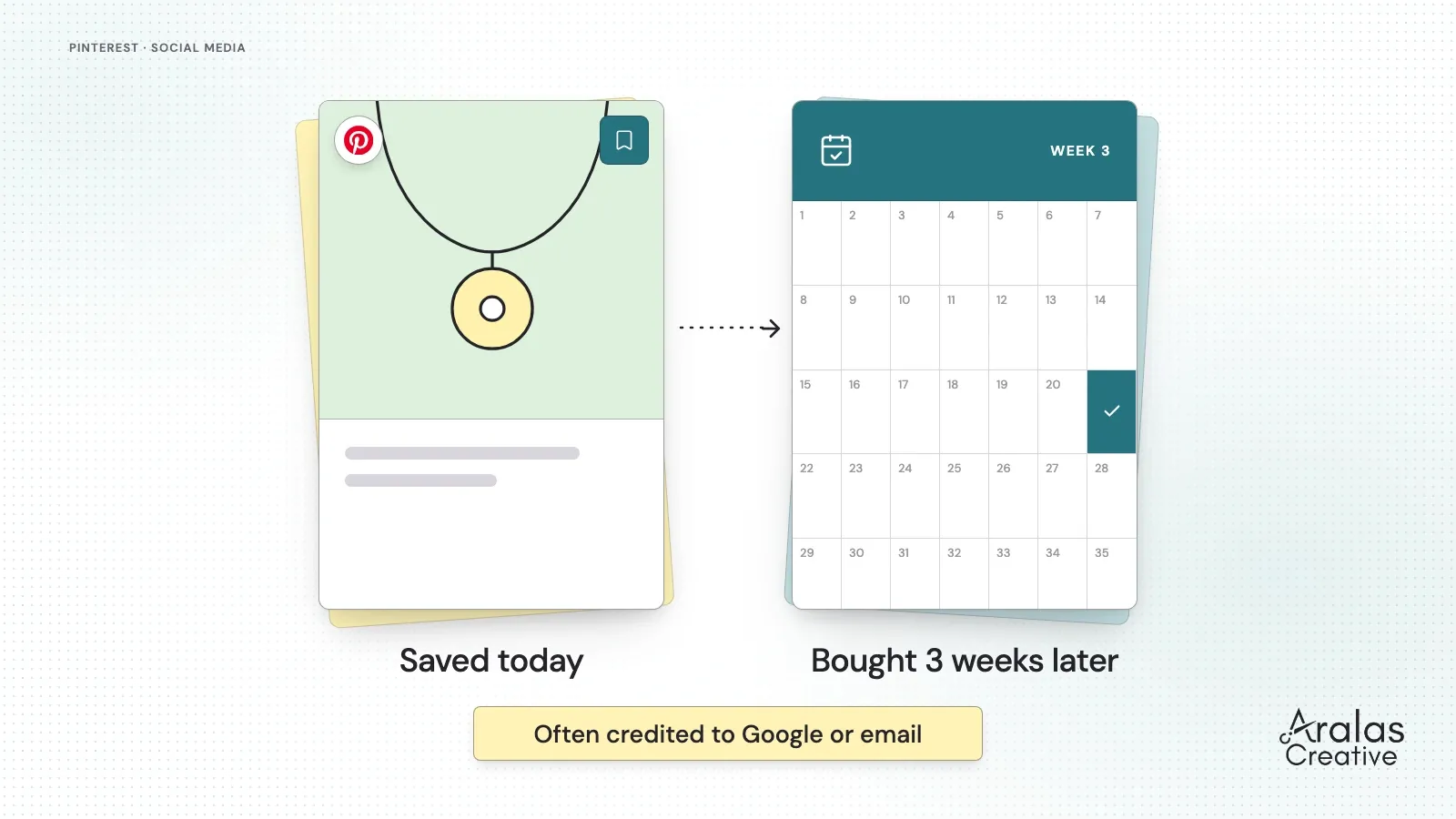
- A spark. They see a bracelet on Pinterest or in a video and think, “I could make that.” People plan on Pinterest and often buy weeks later (more here).
Between the spark and the purchase comes a stretch of comparing and doubting. The next section is about that stretch.
Personas
Now put the buyers together. Write one persona for each buyer you picked, based on real people: your last 10 buyers, their emails and reviews. If you have no buyers yet, talk to three people who fit. Then paste this into an AI tool:
Create a buyer persona for my jewelry making kit shop. Use only what I tell you. If you need more detail, ask me first, and don’t invent statistics.
My kit: [name, craft, price, skill level, time to finish] My buyers: [for each of my last 10 buyers: age range, bought for themselves or as a gift, how they found me, anything they wrote in an email or review]
Give me: a first name and two-line story, why they buy, when they buy, what worries them, what they need to see on my product page, where they look first, and what would make them buy a second kit.
Here’s what a finished persona looks like:
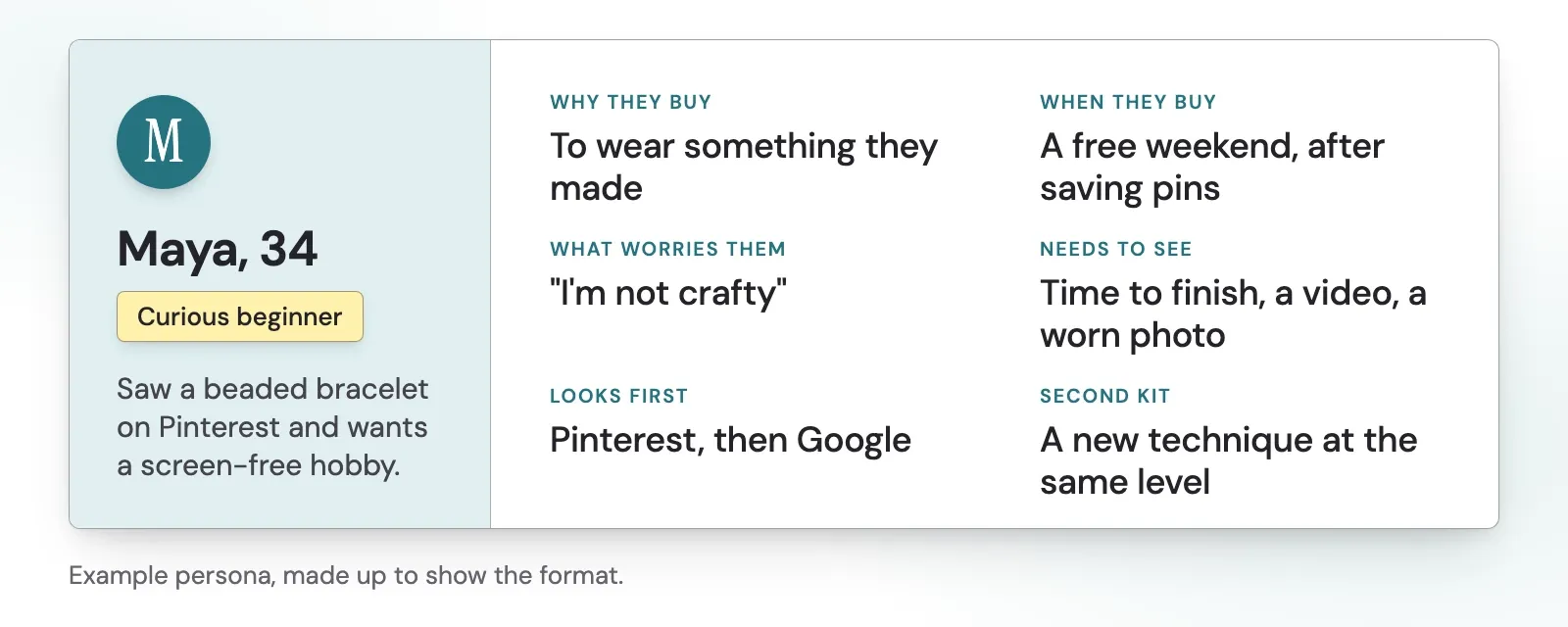
Keep these personas handy. The rest of this guide uses them to choose channels and write your page.
Which marketing channels work for a jewelry making kit shop?
Not every channel does the same job. Some bring new customers, some win the sale and some sell the second kit. Buyers follow the same path before and after they buy, so here’s where each channel fits.
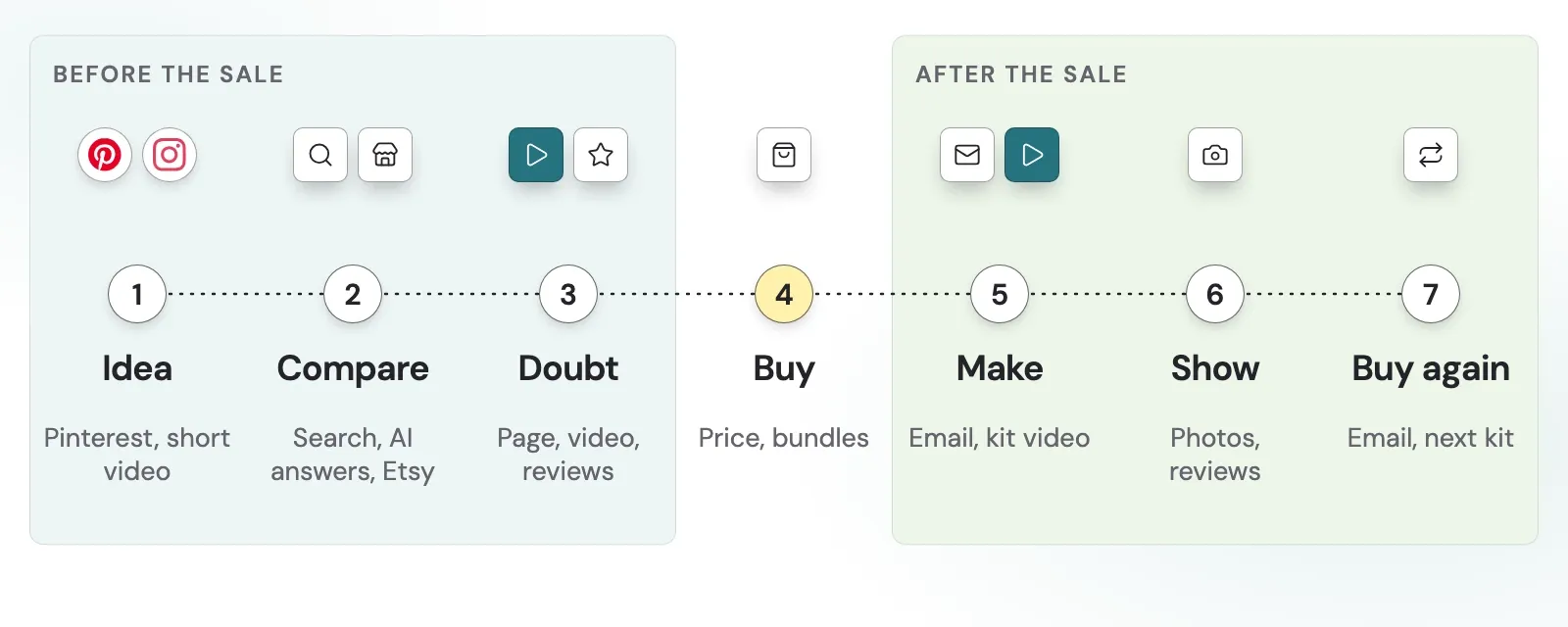
Finding new customers
- Pinterest. People plan on Pinterest and often buy weeks later. It works when your buyers plan gifts and projects and you can wait about three months. Skip it if you need sales this month. Pin the finished piece worn, the kit laid out and the hardest step done, and make boards by occasion and skill, like “Beginner jewelry projects” and “Gifts to make for mom” (more here). Our free Pinterest playbook has a 90-day plan you can follow.
- Google and AI answers. This reaches people who are already comparing kits. It works when your pages answer real questions honestly, like “Are jewelry making kits worth it?” and “Kit or loose supplies?” Skip it if your pages only repeat the product listing (more here). To see whether ChatGPT and Google recommend your shop today, try our free AI answer check.
- Short video. A video shows the hands, the mistake and the fix, so it answers “can I do this?” It works if you can post regularly. Skip it if you’ll post twice and stop. Start with five videos: the unboxing, what’s in the box, the hardest step in real time, a mistake and its fix, and the finished piece worn.
- Etsy. Buyers are already searching there, so it’s good for first sales and first reviews. It takes fees: $0.20 per listing, a 6.5% transaction fee, payment processing, and 15% on sales that come from Etsy’s Offsite Ads (12% once your shop has made $10,000 in any 365 days) (fees, Offsite Ads). For a $40 kit that’s $8.60, or 21.5%, on an Offsite Ads sale at 15%, before payment processing. Don’t rely on it alone. Put a card in the box with a free project and an email signup, so buyers move to your own site.
- Creators. They lend you their audience’s trust. It works with makers who teach a technique. Skip chasing follower counts.
- Craft fairs and workshops. You meet buyers face to face, and it costs time, not ad money. Skip them if your hours are tight.
- Gift seasons. Publish gift pages and your last order date before buyers need them.
- Paid ads. Ads scale what already works. They work once your page converts and a sale leaves enough to pay for the click (how). Skip them while you sell one low-priced kit. The budget section below shows why.
Winning the sale
- Tutorials. Make one video for each kit. Put it on the product page, in the box with a QR code and in the delivery email. It calms the doubt before the sale and helps them finish after it.
- Reviews and buyer photos. Ask every buyer for a photo of the finished piece and put the best ones on the product page. A real buyer’s finished bracelet answers “will it look good?” with a real result.
Selling the second kit
- Email. It’s the channel you own, and the cheapest place to sell, because the buyer already trusts you. It works as soon as you have buyers. Capture addresses with a free starter project, then send the first-week emails (below) and a second-kit offer. Our free email flows playbook has copy you can adapt. To check that email is causing orders, compare against a holdout group (how).
- Level-two kits, refills and bundles. These are what you offer in those emails (more below).
Where to start
Start with what’s free and slow: Pinterest, short video, tutorials and your email list. Add Etsy, Google answers and creators for faster first sales. Use ads last.
FREE PLAYBOOKS
Take the plan with you.
A 90-day Pinterest plan, a Google and AI answers checklist and five email flows with copy. Free PDFs, no signup.
How do you get visitors to buy your jewelry kit?
Channels bring visitors. Your kit page decides whether they buy. Buyers ask three silent questions before they do: can I do this, will it look good, and is it worth it? Answer all three on the page.
Make the page answer the doubt
Every kit page needs:
- The finished piece, worn (will it look good?)
- Skill level in plain words (can I do this?)
- How long it takes (can I do this?)
- What’s in the box, and what isn’t (is it worth it?)
- A video made for this kit (can I do this?)
- Photos from buyers (will it look good?)
- Return terms they can find (is it worth it?)
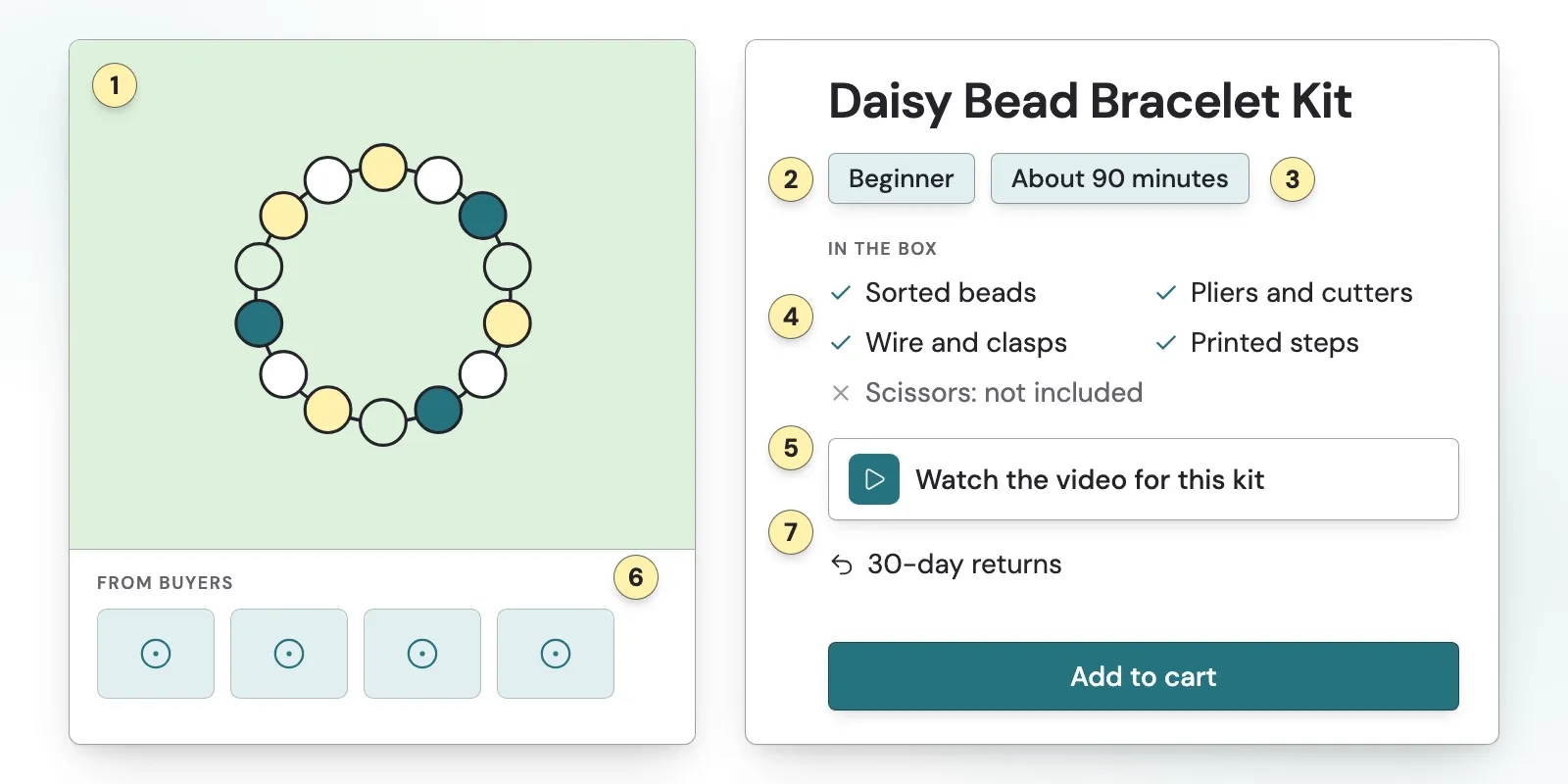
“Beginner” alone doesn’t tell anyone much. “About 90 minutes, no tools needed” does.
Build trust before they buy
Visitors buy from shops that tell them the truth. Show real reviews with finished-piece photos, say what isn’t in the box, and put the delivery time and shipping cost on the page before checkout. Make your return terms easy to find and easy to read, and give a real email address that reaches a person.
Give them a clear choice
Offer a starter kit, a main kit and a gift version, plus a bundle. Work out what each one leaves you first (see the budget section below).
How do you earn trust for the next purchase?
The sale is where trust starts. Buyers who finish and feel looked after come back, and buyers who get stuck don’t.
Make finishing easy
This is where the finished piece is won or lost, and most shops do nothing here.
- Order day: the email includes the video link and how long the project takes.
- Delivery day: “Your kit should be there today. Here’s the first step.”
- Day 3 to 4: “Stuck?” A plain email that goes to a real person. For example: “Hi [name], most people get stuck at [step]. Here’s a 30-second video of it. Or reply to this email and I’ll help.”
- Day 8 to 10: “Show us.” Ask for a photo, and ask permission to put it on the kit page.
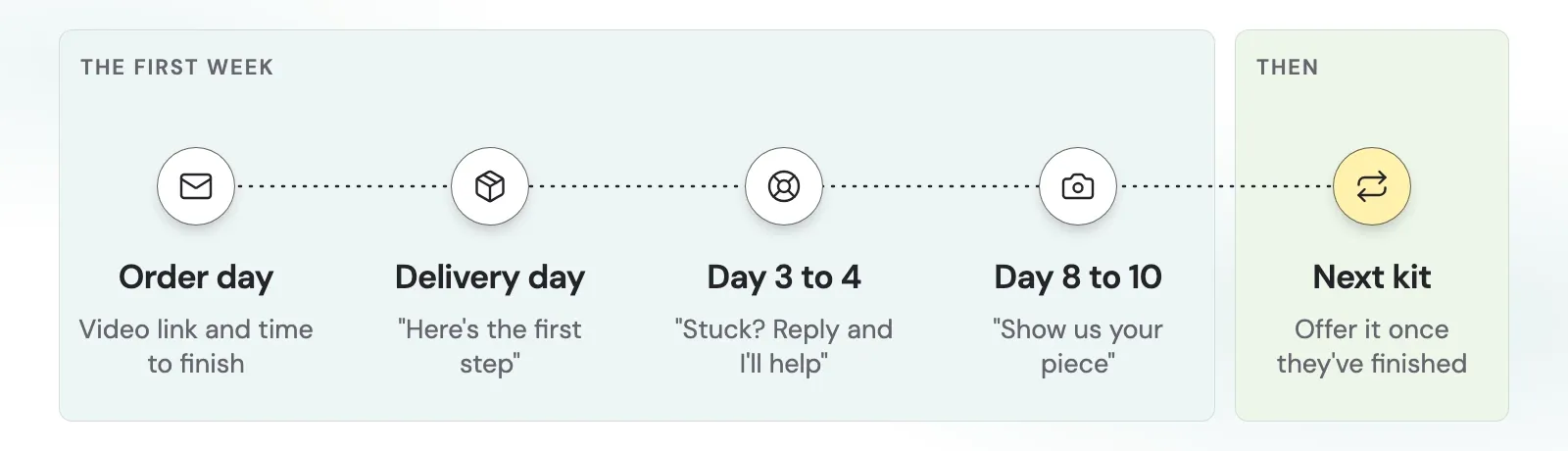
Be there when they get stuck
Reply fast, from a real person. Send a short video of the hard step, or replace a missing part. A “too hard” message tells you what to fix on the page, so treat it as feedback.
Turn finished pieces into proof
Ask every buyer for a photo, and ask permission to use it. Put the best ones on the kit page and on Pinterest, and thank the person who sent them.
Offer the next kit
Once they’ve finished or sent you a photo, offer the next step by email:
- A level-two kit with better tools or a new technique.
- A refill pack for the same pattern.
- A bundle, which also helps your margin, as the budget section shows.
- A kit club, only if you can deliver on time every month.
How do you build a jewelry kit brand people remember?
A brand is what makes people remember you after the sale.
Start with one kit and one buyer
Pick one kit for one of your personas. Beading, wire, resin and clay are different crafts with different fears, and one clear offer is easier to explain than eight half-explained ones.
Stand for something
A memorable kit brand is easy to recognize. Pick one signature and keep it the same every time: name kits after the piece they make, keep the unboxing consistent, photograph finished pieces in the same style, and be honest about what’s in the box.
How do you market a kit shop without breaking your bank?
Start with what’s free
Pinterest, short video, tutorials, honest pages on your site and your email list cost time, not money. Marketplace fees and ads come later.
Where the first money goes
- The page and the kit video. Every channel sends people to them.
- Kits for creators who teach. It costs you the kit.
- Marketplace fees. You only pay them when you sell.
- Ads, last.
What a sale leaves you
Before paying for traffic, work out what a sale leaves you. Take the price, subtract everything that leaves with the order, and see what’s left (same method as in our ad budget guide). Here’s a made-up $45 kit:
| Amount | |
|---|---|
| Price | $45.00 |
| Beads, tools, wire, instructions | $14.00 |
| Packaging | $3.00 |
| Shipping you pay | $6.00 |
| Fees (5%) and refund cushion (3%) | $3.60 |
| Kept per sale | $18.40 |
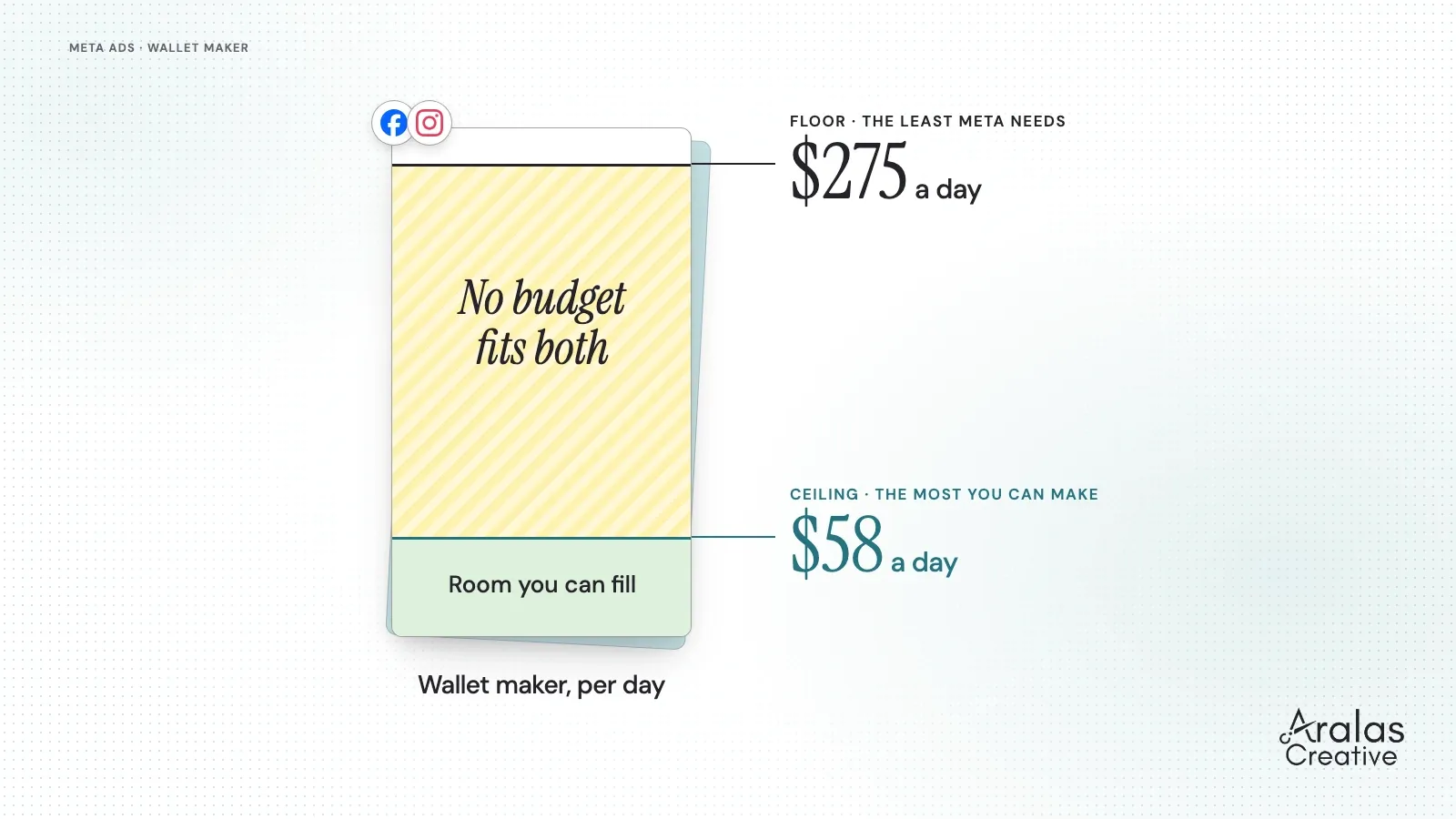
Those costs are invented to show the method, so use your own. Your break-even return on ad spend is the price divided by what you keep: 45 ÷ 18.40 = 2.45. A target cost per sale of 75% of what you keep is about $13.80. Meta says an ad set usually leaves its learning phase after about 50 results in a week, so learning on purchases costs about $13.80 × 50 ÷ 7, or $99 a day, roughly $3,000 a month (the full method).
One $45 kit can’t usually carry that. Now say you sell a three-kit bundle for $120, with $42 of materials, $5 of packaging, $8 of shipping and 8% for fees and refunds. You keep about $55.40, and your target cost per sale rises to about $41.55. Same shop, same ad, but each sale now has room for the ad cost. That’s why bundles, level-two kits and repeat sales matter more than a clever audience setting.
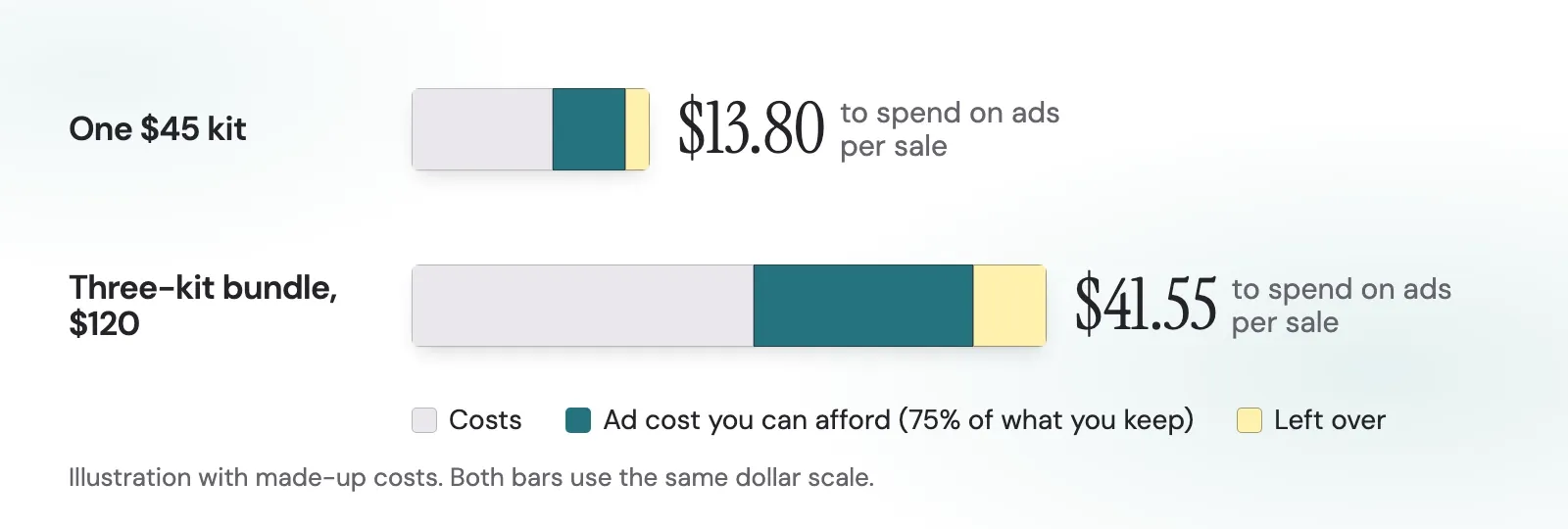
Why isn’t your kit selling or coming back?
Match what you see to the likely cause:
| What you see | Likely cause | What to do |
|---|---|---|
| Sales, but few reorders | They didn’t finish, or there’s nothing to buy next | Send the first-week emails, then a level-two kit or refill |
| Reviews saying “too hard” or “missing tools” | The page promised more than the kit delivers | Add skill level, time to finish and a video, and say what isn’t in the box |
| Traffic but few sales | The page doesn’t answer “can I do this?” | Add the page checklist, a kit video and buyer photos |
| Ads bring sales but little profit | One low-priced kit leaves too little | Sell a bundle and lean on email for the second sale |
Track three numbers: how many buyers say they finished, how many leave a photo and how many order again within 90 days.
NOT SURE WHICH ONE IS YOURS?
Bring your kit page to a free call.
Thirty minutes on where your marketing is stuck and what would help. No commitment.
Your first 30 days
- Week 1: Pick one kit and one buyer, and write the persona. Add skill level, time to finish, what’s in the box and finished-piece photos to the page.
- Week 2: Film one video for the kit and put it on the page and in the delivery email. Write the four emails for the first week.
- Week 3: Post a pin and a short video every few days. Publish one honest “are kits worth it?” page.
- Week 4: Ask every buyer for a photo. Work out what a sale leaves you, and decide whether a bundle is needed before you spend on ads.
If you’d like to work through it yourself, start with our free playbooks. If you’d rather hand it over, Social Growth publishes 200 pins a month from your real product photos, and we set up email flows as a one-off extra.
Common questions
How do you market a jewelry making kit shop?
Start with the buyer: people buy kits to make something, so help them finish. Use Pinterest, search, short video, Etsy and creators to find new customers, tutorials and buyer photos to win the sale, and email, level-two kits and bundles to sell the second kit. Use paid ads last.
How do I get visitors to buy my jewelry making kit?
Answer the three questions every buyer has on the kit page: can I do this, will it look good, and is it worth it. Show the skill level, how long it takes, what's in the box and what isn't, a video made for that kit, finished-piece photos from buyers and your return terms. Put delivery time and shipping cost where they can see them before checkout.
How do I get customers to trust my kit shop for their next purchase?
Help the first kit get finished. Send the video and first step on delivery day, check in a few days later with a 'stuck?' email from a real person, reply fast, and ask for a photo of the finished piece. Then offer the next kit: a level-two kit, a refill pack or a bundle.
How do you market a jewelry making kit shop with no budget?
Start with what costs time, not money: Pinterest pins of the finished piece, short videos of the kit being made, a video for each kit and honest pages that answer buyers' questions. Build an email list from day one. Add ads only once your page converts and you know what a sale leaves you after costs.
Which marketing channel works best for jewelry making kits?
No channel does every job. Pinterest, search, short video, Etsy and creators find new customers. Tutorials and buyer photos win the sale. Email sells the second kit. Pick one channel for each job and start with the free ones.
Should I sell jewelry kits on Etsy or on my own site?
Etsy brings search traffic, but it takes a 6.5% transaction fee, payment processing, and 15% (12% for shops that have made $10,000 in any 365 days) on Offsite Ads sales. Your own site keeps the customer list and the margin. Many shops use both and move Etsy buyers to their own site for the second kit.
How do I get people to finish the kit?
Say how long it takes, include a video made for that exact kit, send the video link on delivery day, and follow up a few days later with a 'stuck?' email that goes to a real person.
How do I get repeat customers for a jewelry making kit?
Help the first kit get finished, then offer the next step: a level-two kit with better tools or a new technique, a refill pack for the same pattern, or a bundle. Send the offer by email after they've had time to finish.
How should I price a jewelry making kit?
Work backward from what you keep. Take the price, then subtract materials, packaging, shipping you pay, fees and a cushion for refunds. Offer a starter, a main and a gift tier, plus bundles, because a single low-priced kit usually leaves too little to pay for ads.
When should I start Christmas marketing for a kit shop?
Work backward from the carrier's last date and your own processing time, then publish gift pages before that date. For Christmas 2026, USPS Ground Advantage's recommended send-by date is Thursday 17 December and Royal Mail 2nd Class is Friday 18 December.
What should I do about reviews that say the kit was too hard?
Treat them as page copy you haven't written yet. Add the skill level, the time to finish, the hardest step and a video of it. Reply to the reviewer, offer help and point them to an easier kit.
Sources & further reading

Omar Sohrab
Omar works across content strategy, search and technical operations. He connects useful publishing with the systems that help people discover it.
Author profile ↗PUT IT INTO PRACTICE
Put the idea to work.
Want help with the work behind a consistent brand presence? Explore the services and choose the support that fits.
Explore our services ↗A correction or a question? Let us know. Read our editorial policy.