The short answer
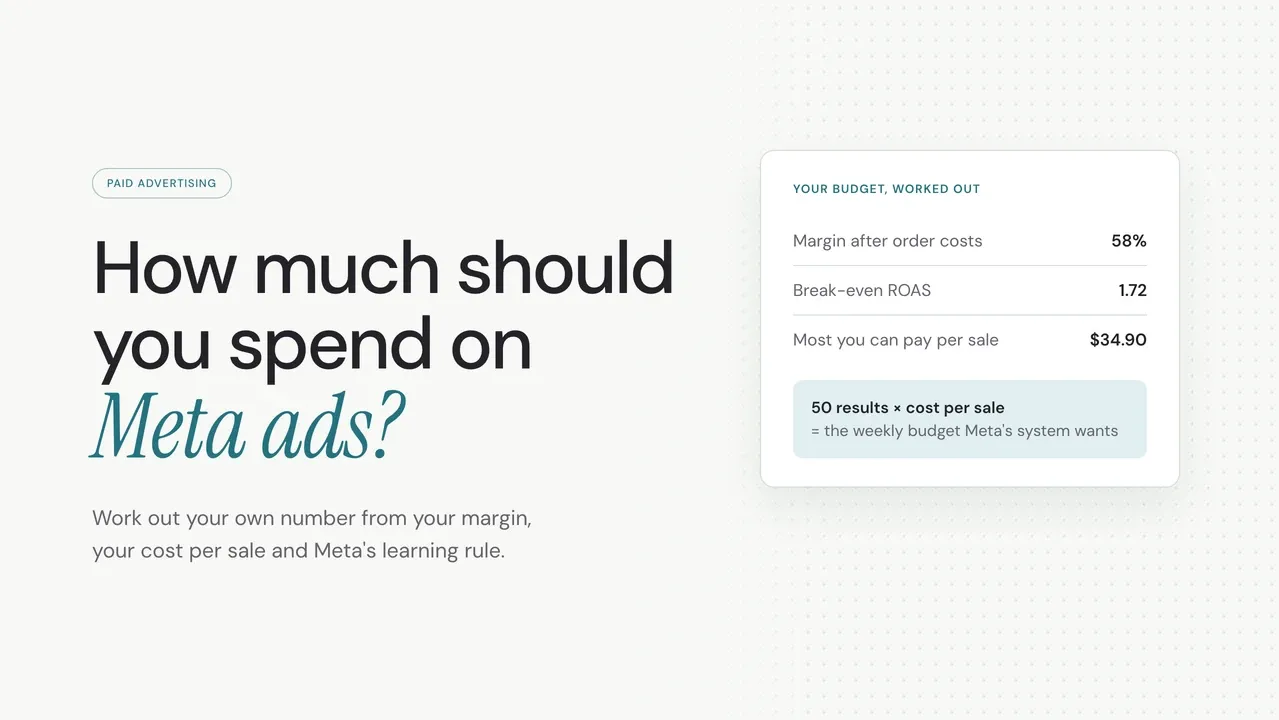
Start from your numbers, not a daily rule of thumb. Work out your break-even ROAS (1 divided by your margin after product, shipping and fees), estimate your cost per purchase, then size the budget. Meta says an ad set usually leaves its learning phase after about 50 results in a week, which costs 50 times your cost per sale. Most small brands can't reach that on purchases, and that's fine: about $1,000 to $3,000 a month in one campaign with a few strong creatives is enough to learn what sells. Below about $500 a month, the money usually works harder on content, email and search.
What to take away
- Your break-even ROAS is 1 divided by your margin after product, shipping and payment costs. Know it before you spend anything.
- Meta says ad sets usually leave the learning phase after about 50 results in a week, so full learning costs about 50 times your cost per sale, every week.
- Most small brands can't afford that on purchases. A focused $1,000 to $3,000 a month test can still show which products and creatives sell.
- Since Meta's Andromeda update, distinct creative ideas matter more than audience settings. Three to five genuinely different concepts beat twenty near-copies.
- If your margin is thin, profit usually comes from the second order, so plan email and retention before you scale ads.
Ask how much to spend on Meta ads and you’ll get every answer from $5 a day to $300 a day. Most of those answers are right for somebody. They’re just not worked out for your products.
One Shopify owner described the confusion well. They’d taken “numerous courses on Facebook ads and they all say something similar: I need to spend $2000+ on Facebook ads during the testing phase.” Their question was whether they could stop at $500 instead. Nobody in the thread agreed on a number, because there isn’t a universal one.
There is a way to work out yours, though. It takes three numbers: your margin, your cost per sale and the amount of data Meta needs to learn. This post walks through each one with a worked example.
How much should a small brand spend on Meta ads?
For most small product brands, about $1,000 to $3,000 a month in a single campaign is enough to learn which products and creatives sell. Below about $500 a month, the results are usually too thin to read, and the money tends to work harder on content, email or search.
To give Meta everything it asks for, you’d need about 50 times your cost per sale every week. At $40 a sale, that’s around $8,700 a month. Most small brands can’t spend that on day one, and they don’t need to. The rest of this post shows how to work out your own figures.
Step 1: Work out your break-even ROAS
ROAS (return on ad spend) is revenue divided by ad spend. Your break-even ROAS is the point where an ad-driven order covers its costs and the ad, with nothing left over.
The formula is simple: break-even ROAS = 1 ÷ your margin after the costs of each order. Include the product, packaging, any shipping you pay, payment fees and an allowance for returns and discounts.
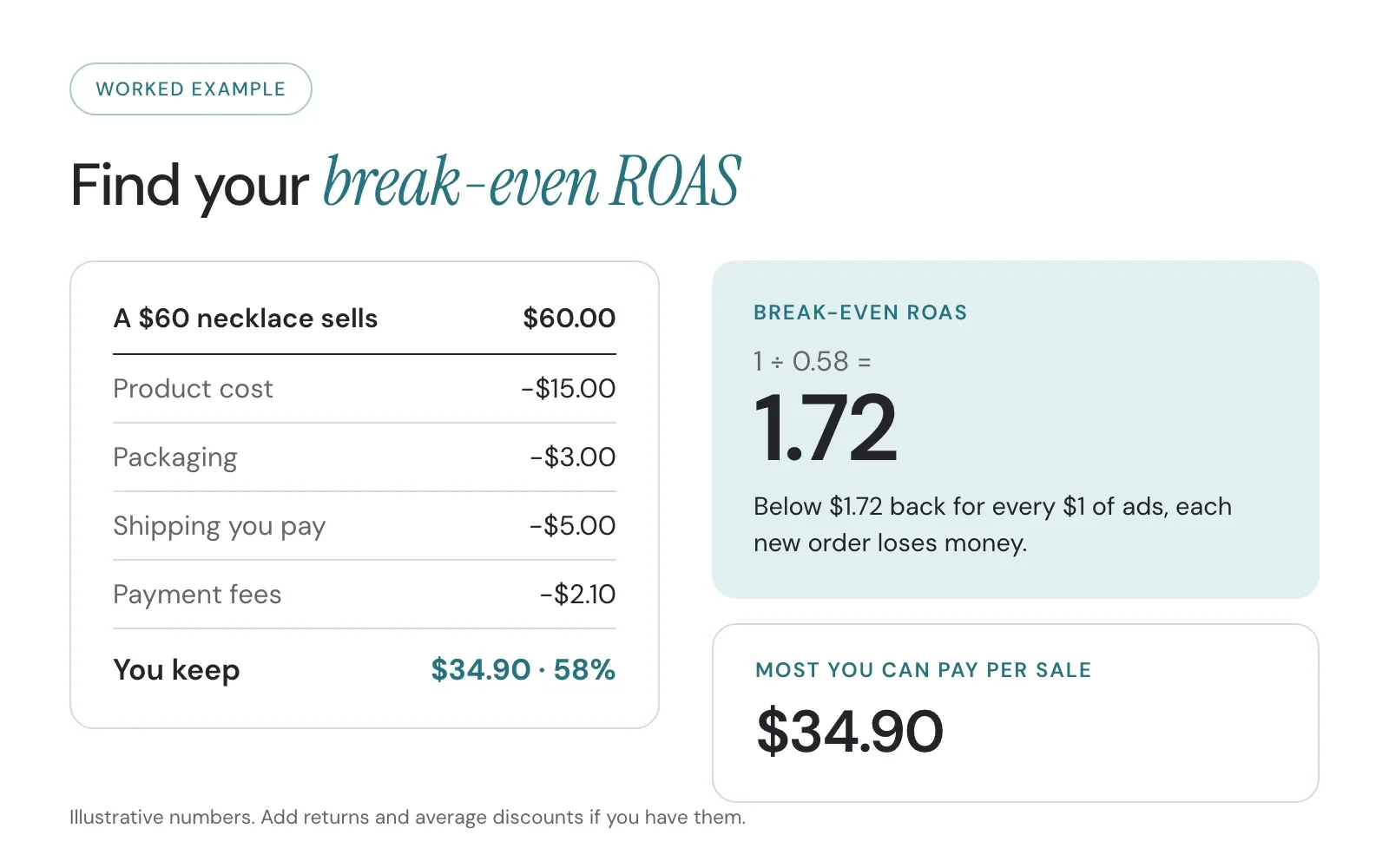
In this example, the brand keeps $34.90 from a $60 necklace. So the most it can pay Meta for a sale and still break even is $34.90, and its break-even ROAS is 1.72. If the ads bring in less than $1.72 for every $1 spent, each new order loses money.
Most owners overestimate this number. It’s easy to forget packaging, free shipping or the discount code that half your customers use. Work it out from a real month of orders if you can.
Step 2: Estimate your cost per purchase
If you’ve run ads before, use your own cost per purchase from the last few months. If you haven’t, benchmarks give a rough starting point.
Triple Whale’s data on more than 40,000 ecommerce brands, reported by Top Growth Marketing for August 2025 to July 2026, puts the median Meta cost per purchase at $38.99 and the median ROAS at 1.88. Top Growth Marketing’s own smaller panel of 15 DTC brands found a median cost per purchase of $49.04, with individual brands ranging from $6.63 to $195.17. Your number could land anywhere in that range, depending on your price, product and creative.
That median ROAS of 1.88 matters more than it looks. Compare it with your break-even:
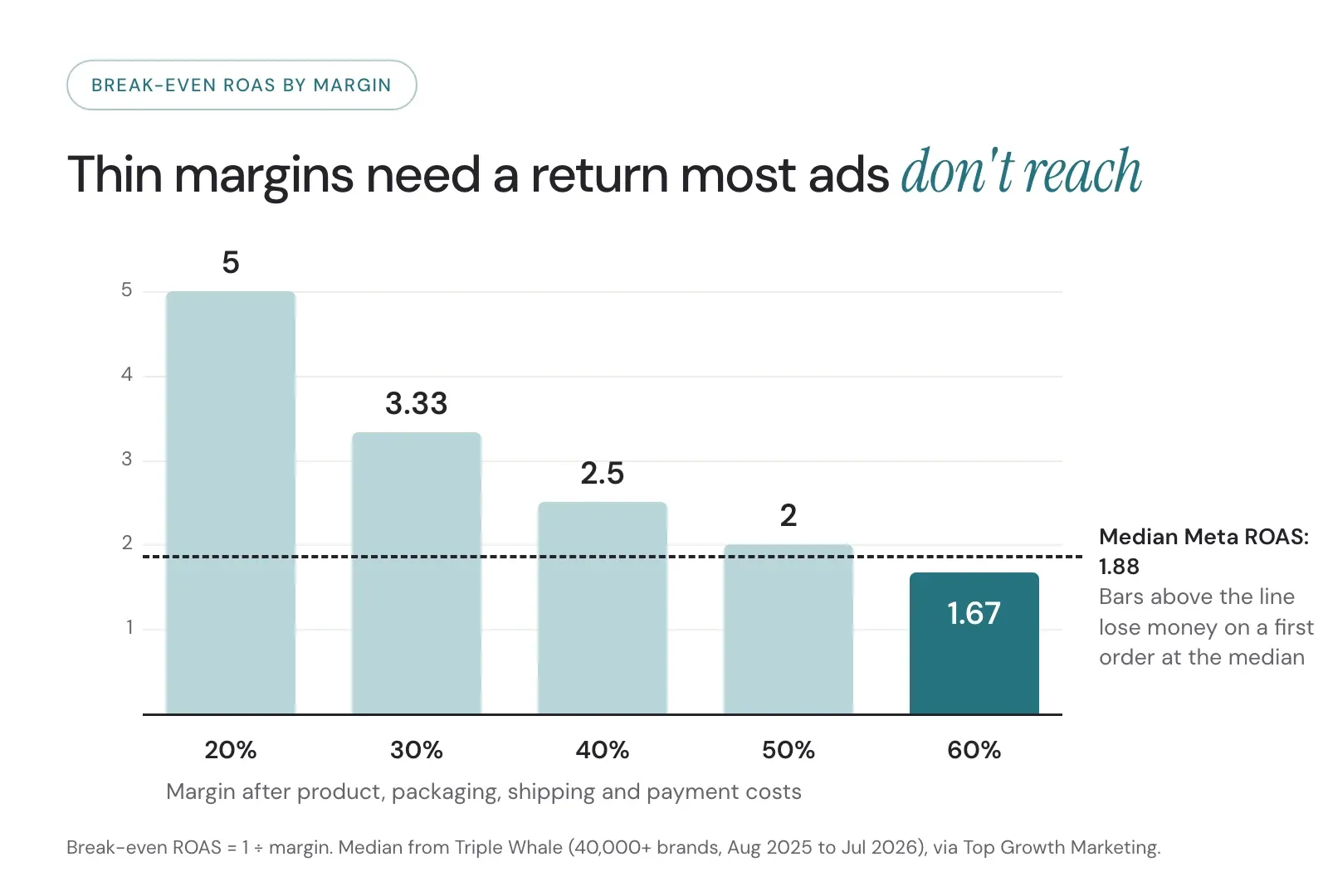
At the median, only brands keeping about 53% or more of each order (1 ÷ 1.88) make money on the first sale. Everyone else relies on customers coming back. That’s why ads and retention go together. If your margin is thinner, plan how you’ll turn first-time buyers into repeat customers before you scale spend.
Step 3: Turn it into a budget
Meta’s ad system has a learning phase. In Meta’s words, an ad set leaves it “as soon as they can deliver stably. This usually occurs after about 50 results in the week after the ad set’s last significant edit” (Meta Business Help Center). Until then, results swing more and usually cost more.
So the budget that gives Meta everything it wants is:
Weekly budget = 50 × your cost per result
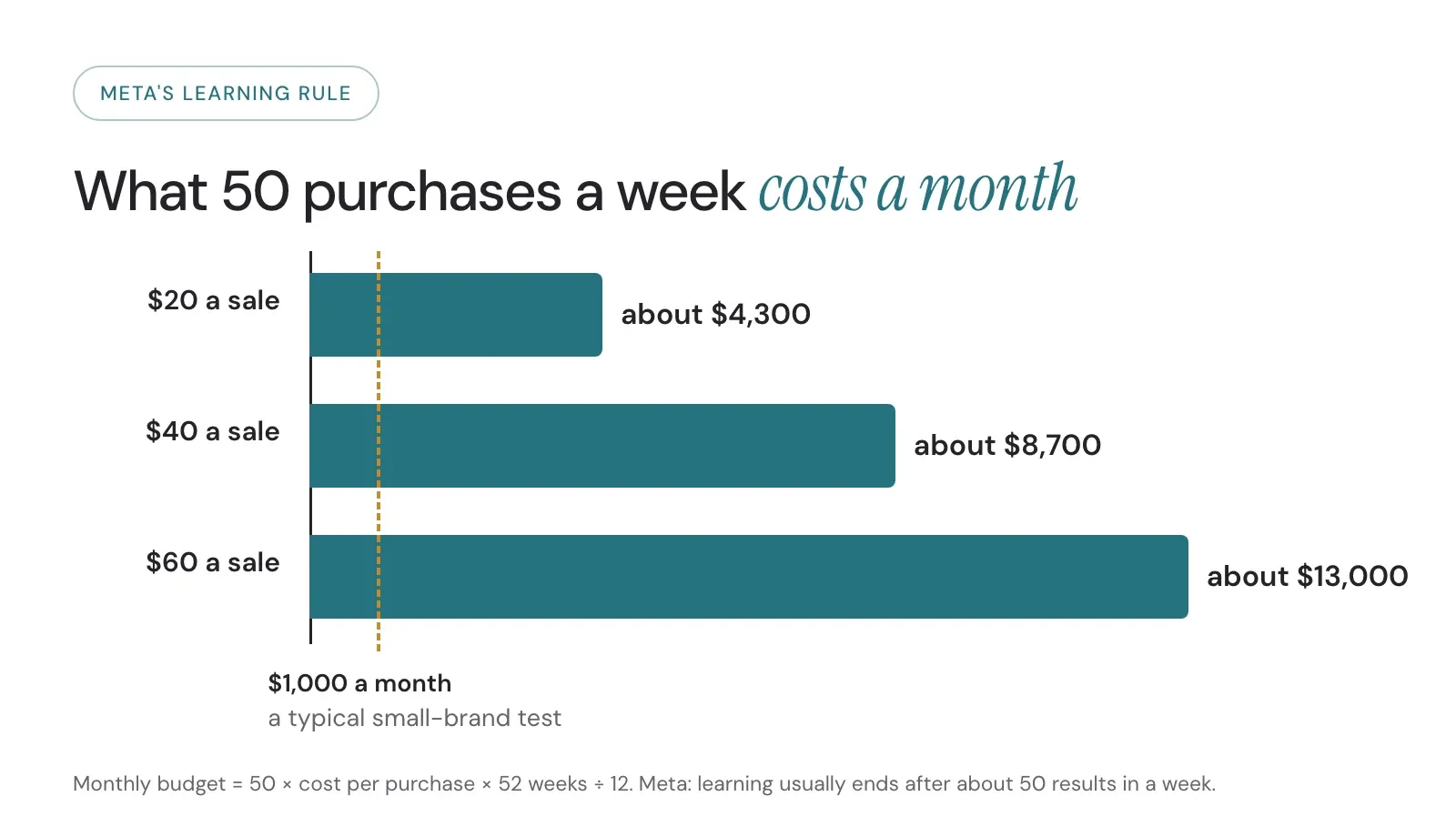
That’s a lot. At $40 a sale, it’s about $2,000 a week for a single ad set. This is where much of the conflicting advice comes from: some people quote what Meta’s system wants, and others quote what a small brand can afford.
Meta’s own advice points the same way. It recommends that you “use realistic budgets,” avoid frequent budget changes, and avoid running lots of ads and ad sets at once, because “when you create many ads and ad sets, the delivery system learns less about each ad.”
What a small budget can and can’t do
Here’s how I’d think about the three levels.
Under about $500 a month. At a $40 cost per sale, that’s roughly 12 purchases a month. A couple of lucky days can make a weak ad look good, or a good ad look weak. At this level, I’d usually spend the money on content, email or search instead, or keep a small budget for retargeting people who already visited your store.
About $1,000 to $3,000 a month. This is a real test for most small brands. Put it into one campaign and one ad set with three to five strong creatives, and let it run for at least four weeks. The ad set will probably show “Learning limited”, which just means it isn’t reaching Meta’s 50 results. The ads still run. You’re looking for which products and creative ideas bring sales at or below your break-even cost.
Around 50 × your cost per sale each week. This is when Meta’s system can learn properly on purchases and results get steadier. Most brands get here by scaling something that already works, not by starting here.
One Shopify Community reply put the very-low-budget dream bluntly. Asked whether $30 of ad spend could be grown into $10,000 by reinvesting profits, the answer was: “technically, yes but in practice it’s a very steep climb.” With almost no budget to test, you’d need a winning ad on the first try.
Creative matters more than targeting now
The biggest change in Meta ads over the last two years is how ads get matched to people. In December 2024, Meta described Andromeda, a new system that picks which ads to show each person from a huge pool of candidates. Meta reported that advertisers using Advantage+ creative with AI-driven targeting saw a 22% increase in ROAS. That’s Meta’s own figure, so treat it as a direction rather than a promise.
In practice, many advertisers now treat the creative as the targeting: the ad itself tells the system who the product is for. Detailed audience settings matter less than they used to, and having a few genuinely different ideas matters more.
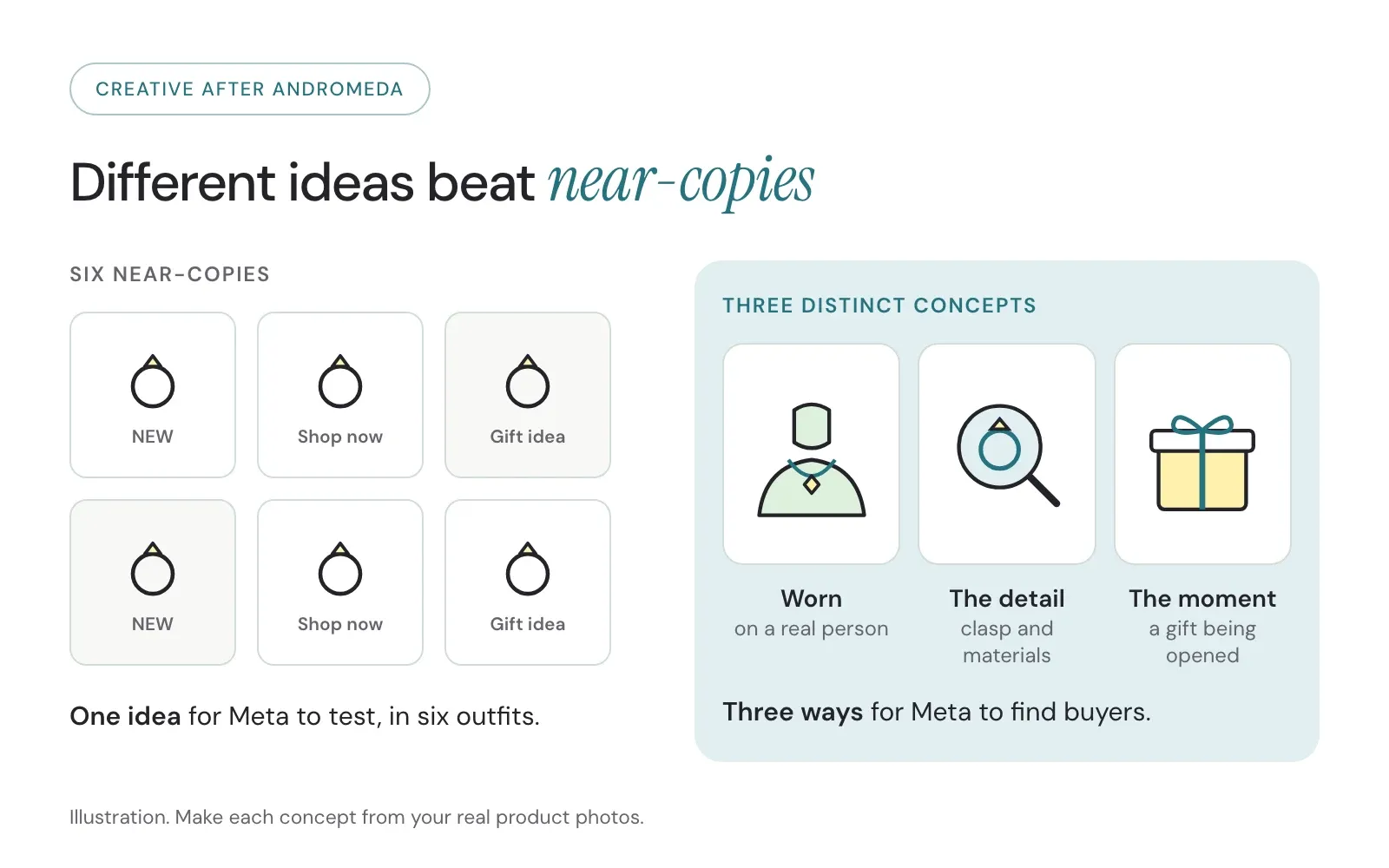
For a small brand, that’s good news. You don’t need a big audience-testing budget. You need three to five creatives that show the product in different, honest ways, made from your real product photos. A ring on a hand, a close-up of the detail and a customer moment will usually teach you more than twenty versions of the same shot.
When you’re not ready for Meta ads yet
Ads speed up whatever is already happening in your store. If something’s broken, they make it break faster. I’d hold off if:
- Your break-even ROAS is above about 3 and you don’t have repeat customers yet. With a margin that thin, first orders from ads will almost always lose money.
- Your product pages aren’t ready. Missing sizes, unclear materials, no reviews and slow pages waste paid clicks.
- Your tracking isn’t checked. If the Meta pixel and Conversions API aren’t sending accurate purchase events, Meta can’t learn from your sales and your reports will be wrong.
- You can’t afford to lose the test budget. Treat the first month as paying for information. If losing it would hurt, build more organic demand first through content, Pinterest or search and AI answers.
How to judge the first month
Give a new campaign at least four weeks before you decide. During that time:
- Don’t keep editing. Meta says edits during learning reset it, so change things on a schedule, not every day.
- Compare against your break-even ROAS, not against someone else’s results.
- Check total revenue against total ad spend, not only Meta’s reported ROAS. Meta’s numbers include purchases it influenced, which can overlap with email and search.
- Look at new customers separately. A campaign that mostly reaches people who were already going to buy can look better than it is.
- Keep the creatives that sell and replace the ones that don’t with genuinely new ideas.
If you’d like someone to work out your break-even numbers and run that first test, that’s what our paid campaigns service does. We start from your margins and check your tracking before any budget goes live.
So, what’s your number?
There’s no single right budget for Meta ads. There’s a right budget for your margin, your price and your stage. Work out your break-even ROAS first, estimate your cost per sale honestly, and pick a budget you can run for a full month without panicking.
So, before you spend another dollar on ads: do you know the most you can afford to pay for a sale?
Common questions
What is the minimum budget for Meta ads?
Meta lets you run ads for a few dollars a day, but that's a technical floor, not a useful budget. For a purchase campaign, a small product brand usually needs about $1,000 a month in one campaign to learn anything reliable. Below about $500 a month, results are too thin to tell a good ad from a lucky one.
How do I calculate break-even ROAS?
Divide 1 by your margin after the costs of each order: product cost, packaging, shipping you pay, payment fees and an allowance for returns and discounts. If you keep $34.90 of a $60 order, your margin is about 58% and your break-even ROAS is about 1.72. Below that, each ad-driven first order loses money.
How many sales does Meta need to exit the learning phase?
Meta says an ad set usually exits the learning phase after about 50 results in the week after its last significant edit. If you optimize for purchases at $40 each, that means about $2,000 a week for that ad set. Shops ads have a separate minimum of 17 website purchases and 5 through Meta.
Is it bad if my ad set says Learning limited?
Not necessarily. It means the ad set isn't getting enough results to finish learning, so delivery is less stable. Your ads still run. For a small budget, keep spend in one campaign and one ad set, avoid frequent edits, and judge results over several weeks rather than days.
Should I spend a percentage of revenue on ads instead?
A percentage of revenue is a useful ceiling once ads are working, and some owners use 10% to 20%. It doesn't tell you whether an ad is profitable. Start from break-even ROAS and cost per purchase, then use a revenue percentage to stop spend growing faster than the business can carry.
How many ad creatives does a small brand need?
Fewer than you might think, but they need to be different. Three to five distinct concepts, such as the product in use, a close-up of the detail and a customer or gift moment, give Meta more to work with than twenty versions of the same photo with different headlines.
Sources & further reading
- Meta Business Help Center: About the learning phase ↗
- Meta Engineering: Meta Andromeda, the next-gen personalized ads retrieval engine (December 2024) ↗
- Top Growth Marketing: Meta ads benchmarks for DTC ecommerce (with Triple Whale medians, 2025 to 2026) ↗
- Shopify Community: Turning off a campaign after spending $500 and no add to carts ↗
- Shopify Community: Low budget ↗
Written by Omar Sohrab with AI assistance for research and editing. Meta's learning-phase wording comes from its Help Center, read on October 30, 2026. Benchmark figures come from the linked report and are medians across many brands, not predictions for yours. The worked example uses illustrative numbers.

Omar Sohrab
Omar works across content strategy, search and technical operations. He connects useful publishing with the systems that help people discover it.
Author profile ↗PUT IT INTO PRACTICE
Put the idea to work.
Want help with the work behind a consistent brand presence? Explore the services and choose the support that fits.
Explore our services ↗A correction or a question? Let us know. Read our editorial policy.